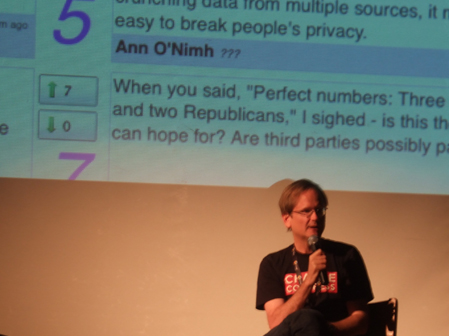
Matt Stempeck

  • Social media as a giant human sensor network critical to the survival of the human race

    “The tribe has grown,” Robert Kirkpatrick notes, looking out at the audience.

    Robert’s the Director of UN Global Pulse. There’s been a lot of data in the crisis mapping community for some time, but it required pro-active collection. Now, we can observe in real time and on massive scale what people are already sharing with each other. And perhaps even more transformative is the “digital exhaust”, the data we generate just by using services around the world. We interact not just with each other, but with businesses and maps and search. The private sector has spent trillions of dollars building the cloud, and now we have human sensor networks that map immediately to human needs. We can passively observe collective human behavior in realtime.

    This is not the world in which the United Nations was founded. Everything moves faster now. The pace of change has absolutely exploded, and I don’t think it’s ever going to slow down. Realtime isn’t just faster; it’s fundamentally different, and requires different rules.

    2011 was a pretty significant year for data. More data was created last year than all of human existence before. Facebook hit a billion people last week. If social networks were countries, they’d be the top six populous countries in the world.

    Mobiles, cloud, and social combine to produce ever larger amounts of data.

    Jakarta is the tweeting-est city on earth. When we map the tweets, it’s clear that Indonesians spend a lot of time sitting in traffic. They take tons of photos, too.

    The point of all this data?

    Hopefully,
    1. Better early warning to detect trends, anomalies, and allow earlier response
    2. Real-time awareness, with a better picture of needs supporting more effective planning and implementation
    3. Real-time feedback to understand sooner where needs are changing, or not being met, to allow for more rapid iteration

    The point of real-time data is that we get the information in time to do something with it. The feedback loop allows us to intervene and change the story before it’s over. Months-old nutrition data does little to help hungry people.

    There are many research areas to explore, from preparedness to migration to climate change adaptation. Huge populations are moving to urban slums. Program Monitoring and Evaluation keeps coming up — can we get faster feedback on whether our programs are having the desired effect, rather than wait until the 3 year program cycle is over? And can we use some of these data techniques to approximate statistics? Mobile providers have modeled phone usage and can project, with 80% accuracy, a user’s gender and age.

    As an example, let’s look at how we can use mobile networks as drought sensors in the Sahel.

    Problems, we’ve got
    Privacy, validation, access to data, and that most existential of questions: does it actually change anything? If the organization responsible doesn’t act, does it matter if we have all of this data and its insights?

    Big data is a huge human rights issue, but it’s a source of tremendous risk, as a raw public good. Three draft guidelines:

    1. Never analyze personally-identifiable data
    2. Never analyze confidential data
    3. Never seek to re-identify individuals

    Rob finds a space between Mark Zuckerberg and the nation of Germany in the spectrum of whether data privacy is pointless or sacrosanct. It’s a public good, but it comes with risks.

    User-generated data poses additional challenges. People lie. Dark areas on a social network map don’t represent areas not worth tweeting about; our sensor network is unevenly distributed.

    NLP isn’t great at sentiment, particularly sarcasm or irony. A tweet can contain gigabytes of context instantly apparent to a brain with hundreds of thousands of neurons, and nothing to a computer.

    Behavioral data has selection bias from the start.

    Media coverage itself drives behavior change, so it’s tricky to measure cause and effect.

    Apophenia: We sometimes think we see trends where there are none. Correlation is not causality.

    This crowd data is faster. It’s not a replacement for the hard evidence and existing methods. But its speed can change outcomes.

    Telescopes and macroscopes each have their own issues. 96% of the universe is dark energy or dark matter, which doesn’t reflect light. Likewise, most of our data is behind corporate firewalls or is otherwise unshareable. So much of the information about people is not available to the people charged with representing them and ensuring they are healthy. Can we find a way to share data that doesn’t compromise business or privacy?

    The future of the human race

    This isn’t just about corporate social responsibility. If we could get the private sector to engage in sharing some of this data in a way that doesn’t produce business risk… Many business recognize that this volatile world is a terrible climate for business. We need a global real-time public/private data commons. Which models, tools, and technologies would allow a data commons to work for everyone?

    “We think a data commons is the only way we are going to survive as a species for the next 100 years.”

    Getting there will require safe space for experimentation. Many attempts will not work, but need to be tried.

    Pulse Lab Jakarta is a shared facility with data scientists, research fellows, and private companies with tools and data to share. They’re actively recruiting partners to experiment in the most social-media-rich area of the world.

    Additional labs will follow. Kampala, in east Africa, is less of a social media hub, but offers extraordinary opportunities for financial data. Makassar, in South Sulawesi, and Medan, in North Sumatera, are also regions of focus.

    Issues of interest include food prices, urban poverty, and financial behavior.

    The UN is a platform, which requires partners. They partner with governments to establish Pulse Labs, conduct research, and make it available to the world.

    Their approach uses different data sources for various purposes. Twitter’s great for food prices, and useless for fears about job security. They correlate this information with official data sources, and visualize trends and map the results.

    Some tools:

    1. ForSight gets a shoutout for monitoring conversations based on keywords. The global soybean shortage leads to a big spike in conversations about tofu and tempeh.
    2. Global Pulse also uses SAS’s Social Media Analytics and Text Miner tools
    3. They’re using linear regression analysis of social media conversations to determine if they can predict inflation of certain types of food. When prices go up, people tweet about that food. Except eggs. Indonesians tweet more about eggs as the price drops (“Mmm…omelet”).

    Does this finding apply elsewhere? We’re going to need to map what these findings mean, and where they apply.

    Our social media signals are getting stronger. People talk about basic needs using social media more than they used to. And the temporal correlation is growing stronger, too. Greater distribution of the human sensor network improves our results.

    Our weather tools are pretty sophisticated because they pull from a large number of weather stations AND algorithmic detectors. Could we do the same for the monitoring of human networks?

    This community is at an inflection point. The data’s everywhere, the tools are taking off, and the future’s exciting.

  • A word from the #ICCM Sponsors

    • Neils Holms-Nielsen, of the World Bank and the Global Facility for Disaster Recovery and Reduction, says this event is quite important for them. The cost of disasters annually has grown for the past several decades, much faster than the global economy (not that the global economy is growing too quickly, these days). This is a problem from a development point of view. For about half of the world’s nations, disasters pose a significant hurdle to development. Neils is heartened by the people, ideas, and technologies represented in the room. The World Bank cannot address this problem on its own, and looks to build stronger partnerships and relations with the emerging field of volunteer technology communities.
    • Salim Saway works on ESRI‘s Global Affairs team. They’ve attended all four CrisisMappers conferences, and sponsored the last three. They support the disaster relief community with data, tools, and licenses.
    • Christiaan Adams is here representing Google’s Crisis Response team. They’re excited by the data, collection of imagery, open tools, standards for sharing, and other developments. He says that crises force us to think faster and more creatively than usual, and encourage an environment of community and collaboration.
    • Tara Cordyack of GeoEye points out the critical need for commercially-available satellite imagery in a crisis. Time and time again, having this imagery leads to lives saved, money saved, and infrastructure saved. They’re happy to support this community with imagery and analytical services.
    • Dan Palmer, professor of Computer Science at John Carroll University. They hosted the first CrisisMappers conference. They’re a Jesuit university focused on helping others, social justice, and engaging with the world. On campus, they have a Center for Crisis Mapping, working in crowdsourcing and spatial analysis. It’s not a single academic discipline or department. Sociologists, computer scientists, and many more fields are brought into the mix. They are planning an expedition to Uganda to map resources.
    • Camille Cassidy of Digital Globe also provides earth imagery, with three satellites providing imagery for a range of uses.


  • Smarter Cities, Better Use of Resources?

    Dr. Lisa AminiIf you’ve read a magazine or traveled through an airport in the last couple of years, you’ve probably seen ads for IBM’s Smarter Cities initiative. Today in our Post-Oil Shanghai course, we got to learn about some of the projects behind the very public campaign. Dr. Lisa Amini is the first director of IBM Research Ireland, based in Dublin. They focus on creating urban-scale analytics, optimizations, and systems for sustainable energy and transportation.

    Lisa’s group focuses on transforming cities with:

    1. Sensor data assimilation: how do we ensure data accuracy, and account for the volume of data that comes in from sensors deployed at a metropolitan scale?
    2. Modelling human demand: how do we design a robuest enough model to reliabily infer demand and peoples’ use of city infrastrucure
    3. Factor in uncertainty: we’re talking about humans, here.

    Sensor Data
    Smarter CitiesWe have a massive amount of diverse, noisy data, but our ability to use it productively is quite poor.

    One reason Lisa’s team is based in Ireland is that Dublin shared their municipal data on energy, water, and other core services. IBM wanted to focus on making use of available data, not laying down new sensors. Lisa shows us a map generated by bus data. The data is much more granular at the city center than in the suburban outreaches. And even downtown, the GPS isn’t terribly accurate, and sometimes locates buses smack dab in the middle of the River Liffey. This complicates efforts to infer and improve the situational awareness.

    Bus bunching is a major problem in cities. Buses that begin ten minutes apart get slowed down, and end up clustered in bunches, with long waits in between. One goal is to dynamically adjust schedules and routes to compensate for predictable bunching conditions.

    Another project looks to improve traffic signalling, not just for public transportation, but all traffic. Scientists are finding links between vehicle emissions and health, and certain urban corridors and certain times see a dangerous buildup of pollutants. Smarter planning could help us at least prevent this buildup from taking place around schools and hospitals.

    Lisa talks about Big Data, but also Fast Data. It’s continuously coming at you, and if you can leverage it in realtime, it can be much more useful than a study conducted well after the fact. Her team is working on technology to make use of data as it comes in, and construct realtime models and optimizations. They can see bus lane speed distribution across an entire city of routes and a fleet of a thousand buses, accounting for anomalies past and present.

    Sensor data’s great, but what do you do when a segment of the bus route is flashing red? Often, a disruption requires a person going to the scene to find out what’s wrong. The IBM team is experimenting with using Natural Language Processing data to determine if the cause of traffic is a Madonna performance at the O2 Centre. They can analyze blogs, event feeds, and telco data. Twitter isn’t useful for this yet because of the low percentage of Twitter users with geocoding enabled on their tweets.

    Congestion is a significant contributor to CO2 emissions, so proative traffic control is becoming an important tool. Europeans are more and moer concerned about the livability of their cities, and even when they’re not, the EU Commission is happy to regulate. Cities are excited to avoid paying heavy fines, and invest in technologies that help avoid such costs.

    At the individual level, congestion charging only works if there’s a reasonable alternative to driving. Even then, Praveen notes, it creates equity issues, where the wealthy can afford to drive into the city, and the poor cannot.

    Lisa’s team is also modeling coastal quality and circulation patterns. One of the big problems is the treatment of water in waste plants. These plants treat the water to a static chemical index, and then release the water back into the world. Marine life dies, and we have toxins in the water, because
    Large rainfall creates road runoff into the wate system. And tidal conditions can push water back upstream and hold the toxins in place, killing marine life. People are deploying sensors across the water systems, which is a huge improvement on annual testing conducted by a diver. But sensors don’t work incredibly well underwater – they’re limited by range and “fouling” of data.

    New technology uses light sensors to understand the movement of water, which, combined with other sensors and de-noising models, can produce a cleaner picture of what’s happening across the bodies of water.

    Modelling Human Demand
    How people move, interact, and how they prefer to consume resources.
    They can improve city services by taking advantage of telco data, smart car data, and other private and public information. The findings show a surprising sapital cohesiveness of regions. Geography still plays a huge role in how we look for services, communicate, and travel. Cellphone path data can illustrate points of origin that can better inform the planning of transportation paths. Political lines are a particularly ineffective way to organize services.

    In the energy space, two trends have converged: First, we have more and more renewable energies, but they’re only available when the wind blows and the sun shines (efforts to store this energy notwithstanding). Our fossil fuel power plants require careful management, and must be gradually. Ireland could actually use more windpower than they currently do, but it would have adverse effects on the traditional plants.

    The second trend is smart meters, which provide much more information on how energy is used. This allows for demand shaping, dynamic pricing, and smart appliances that act based on this information. But the energy companies are structured around predicting national energy demands, and follow very conservative policies that optimize for fulfilling peak demand. Energy companies are learning to forecast energy demands for pockets, rather than huge regions, and to take advantage of reneweable energy sources with pilot projects. They foresee running hundreds of thousands of dynamic energy models, rather than their current one-model-that-rules-them-all.

    A project with Électricité de France simulates massive amounts of realistic smart meter demand data to test future scenarios. They’re building additive models based on human events like holidays and residential vs. commercial energy usage. The IBM Research team has build complicated flowcharts to identify compelling datastreams.

    Uncertainty
    Utility leaders are forced to make decisions that are fraught with risk and uncertainty. It’s not just optimization, but social welfare and balancing competing costs. Lisa would like to incorporate the notion of risk into the technological systems. When your phone tells you there’s a 10% chance of rain today, it’s not very actionable information. Medical tests and treatment plans can be equally infuriating in that they fall short of complete predictability. How do you communicate information that carries risk with it so leaders can make decisions?

    Interconnected water systems, with water treament plants, households, and geographical features demanding different priorities. Water utilities spend enormous amounts of energy moving water from one place to another, losing between 20-70% of the water along the way. We need to begin considering these systems as integrated, and acknowledge the risk and uncertainty inherent within them. When you start working on any one aspect of city services, you quickly involve other departments.

    There have been many studies on providing energy and water information to homeowners to encourage conservation. The biggest change you can make? It’s not laundry or watering your lawn. Fix your leaky faucet.

    Culture matters, too. Europeans expect more of their government, and citizens get up in arms when a resource like water becomes metered.

    Rather than produce a perfect formula and answer to a question like municipal water demand levels, they have built models that allow for imperfections in data and can optimize for cost or service delivery.

    An area of hope is to target non-experts with well-communicated information and visualizations of existing data.

    What would you do if you had a city’s worth of data?
    Lisa’s team is working to convince the city of Dublin to release more municipal data for others to make us of, following in the footsteps of Data.gov, Washington, DC, and San Francisco.

    The Social City project seeks to better understand the social context of people in a city to better understand why certain groups of people aren’t getting the resources they need. The conditions in which these people live could be major drivers of why

    Q&A

    Sandra: Have you thought about incentivizing people, rather than just providing information?
    Lisa: Incentives don’t need to be financial. One study found that knowing how other people like you behave has the ability to change individual behavior.

    Praveen: Is it feasible to offset the cost of installing smart meters with the energy savings it provides?
    Lisa: Right now, it’s still a net loss, because you still don’t have systems on the energy utlity side to take advantage of smart meters. But utilities know their time to adjust is limited, and governments are helping utilities to see that their time is limited.

    People like to see immediate changes when they alter their behavior. Anything you can do to show people a change early in the feedback loop can be powerful (anecdotally).

    Q: Can we do a better job of choosing sites for our buildings?

    Lisa: There’s great data for this, but there are a lot of difference influencers. The telco data and the social context projects, for example, show just how many factors are at play. People may take advantage of a welfare system, but in the data, we often see them pop up once, and then disappear. They may register under different names. Cities know their service centers aren’t meeting peoples’ needs, often because of inconvenience of location.

    Zack: There are a lot of policy implications in your work, and new technologies at play. You’re also in a position to educate policymakers and advocate for specific policies. What kind of barriers do you run into talking to those folks?

    Lisa: Where it works is when you find some city leaders who are incredibly passionate about trying to do better and fix their city or some aspect of their city. Predominantly, people take these jobs because they do care about the city and services and infrastructure and making that better. The challenge is that a lot of policy and politics and regulations at larger levels that an individual leader can’t work around. Bus drivers’ union leaders were initially upset about the city sharing the Dublin buses’ GPS data. Are you going to spy on my lunchbreak?? Cities have histories and personalities and election cycles. Some people are afraid that the data will paint a negative picture of their work. Lisa compares it to the tide: sometimes you just can’t command it due to its scale. Leaders can’t yet prove a return on investment on a project because there’s so much uncertainty.

  • How to Surface the Valuable Resources All Around Us

    I started my morning with an exciting (to me) development: Verizon had finally approved the Jelly Bean update to my Android phone. One of its features, Google Now, works like the iOS 6’s Passbook. Both systems pull from the vast number of things your phone and connected services know about you to surface relevant information when and where you need it. The day’s weather, the score of your favorite sports team, and traffic on your commute home are pushed to you so that you don’t even have to search. It was a fitting way to start the morning as I headed to the PhD. thesis defense of Polychronis Ypodimatopoulos (or Pol, or @ypodim, if you’re a fan of brevity).

    The question that has guided Pol’s research is how we can enable people to easily tune in to what’s going on around them. When a curious mind walks into the Media Lab, how do they find out all of the amazing things happening inside this building? The Lab has Glass Infrastructure screens, but most other buildings do not.

    The pain point here is the “If only I had known…” feeling. We work on projects similar to others, without ever connecting. We could better exchange products and services, engage in joint activity, or pool resources, like finding a roommate.

    Cities offer many resources and opportunities, but navigation remains a daunting challenge. High rise buildings and crowds make us feel intimidated, not empowered. How can technology help us see our neighborhoods as the rich hives of potential they really are?

    Pol’s answer is the decentralized social network. His first application was a mesh network on a mobile device that showed you what was around. Writing apps on multiple platforms and limitations of battery life were issues, though. So he moved the network to the cloud with Ego. Ego sought to put the user at the center of activity, with apps circling us, rather than our current model of competing platforms, where users revolve around sites like Facebook and Amazon.

    Pol added indoor location-sharing to the mix with Bluetooth devices. The Twitter-like interface allows you to literally follow your friends. He charted the aggregate location results of two competing sessions at the same event, and could visualize the depressing effect poor venue selection has on the size of your audience.

    The aforementioned Glass Infrastructure is a place-based social information system comprised of 40 touch screens placed around the building. It maps out the Media Lab’s many people, groups, and projects for visitors. By exposing this information in a public place for the first time, students rushed to update their projects and headshots (this novelty effect has worn off, however).

    The GI architecture consists of a large touch screen in vertical orientation, which can read RFID tags on the nametags of passerby. This allows the infrastructure to provide different applications for different user classes (Media Labbers, sponsors, visitors).

    The Bird’s Eye View application for the Glass Infrastructure provides a collage of faces. When you walk by the screen, your photo is pinned for the next 5 minutes so that others can see your recent presence and potentially reach out to you.

    These two projects introduced a decentralized social network and a place-based social information system, but Pol sought to create a discovery mechanism that works across different contexts. Siri and Google Glass are interesting ways to present the information around us, but Pol thinks there’s room for improvement in creating the actual content of what’s interesting around us.

    One such application is discovering the experts around us. This is usually done by starting with a corpus of information, such as emails or a forum, and then identify and suggest expertise. But when you’re in a new space, you don’t have such a corpus. FourSquare doesn’t tell us much about the people around us. Twitter has hashtags, but we have to advertise that hashtag’s existence before people know to use it. Starbird, et al. proposed hashtagging everything, which gets messy quickly. And combining Facebook + Highlight limits you to your existing social network’s reach.

    Pol pulls up his own Facebook Profile. There’s a lot of information here, but it’s not enough to capture him, especially when you throw variables like location into the mix.

    Brin.gy is a discovery service that centralizes our skills across users. It’s designed so that multiple discovery services could compete using the same format. You, the subject, list objects (topics) paired with a predicate (talk to me about these topics).

    Pol simulated the discovery service with thousands of users at the scale of a city block. A coffee shop owner would be able to determine how many people walking by match the profile of a person likely to buy coffee. Pol sees this as a way to make markets more efficient, and let consumers group themselves to achieve better prices.

    This being MIT, most of the skills listed in the demo are software development skills. Your personal taxonomy consists of tags for your skills, gender, and languages spoken. The average user contributed 15 values about themselves, which is actually the same amount of datapoints Pol found in Facebook Profiles.

    Pol tested Brin.gy at O’Reilly Ignite Boston 9 to help attendees find people they might want to talk to. TED has actually produced a similar iPhone app, TEDConnect, with the same “Talk to me about” field.

    This list of information doesn’t scale, though. It quickly becomes unwieldy. So Pol looked at exposing information selectively based on the user’s current context. The lists become applications based on specific geographically-defined areas depending on whether you’re looking for dinner or a study partner.


    Pol also mined a useful Media Lab listserv discussion to extract the knowledge within and import it into Brin.gy. He mapped the tips and displayed . He asked users which format they preferred. People like the email thread for the personal touch and the contextual information provided in each email. But it takes a long time to digest many emails in a thread. Brin.gy extracted the valuable data, but not the personal stories behind it.

    Q&A:

    Me: Are we forever doomed to choose between inefficient but meaningful personal narratives and rich, if soulless, databases?

    Pol has attempted to design a sweet spot between the two, and points to databases that link back to the personal context as a solution. Bring.gy provides a map with database entries of rich, concrete information, but each entry also shows the faces of the people who made the recommendation and a link to the email where they tell the story behind that great shot of espresso. You can have the best of both worlds.

    Eyal asks if Pol has considered the emergency applications of such a skills database. Could we quickly determine if there’s a doctor in the vicinity?

    Pol points out that verification of one’s medical degree would be important in such a scenario. Pol has played out a scenario where your train station is closed, and you are able to hitch a ride with someone headed the same direction. But realtime location sharing apps will probably leapfrog Pol’s tag-based attributes in this specific application.

    Catherine Havasi notices a number of Google Maps pins in the Charles River and asks about moderation and verification. It turns out this was intentional, for a flashmob-by-sailboat app. But in general, Pol relies on user flagging for crowd moderation.

    Privacy is managed by users themselves, who can set how many degrees of Facebook friend can view their location and attribute information.


  • Wiring Informal Economies with Square

    Jack Dorsey (@jack) is a double-timing executive. He spits his week between Twitter and Square, two fundamentally game-changing companies he has founded. You’ve probably heard of Twitter. And you’ve likely heard of Square by now, as everyone who uses it inevitably becomes an advocate for the service. Every time you see a cab driver or food truck faced with the decision to either not accept credit cards or pay high vendor setup costs, you feel compelled to share the gospel of Square’s free setup and bare minimum processing fee (2.75%).

    Jack starts with the story of two nice guys who founded a pizza company together. To keep the company intact, they promised not to date the waitstaff. Until they hired Jack’s mother. His dad broke the interoffice dating rule and gave up the pizza company. The moral being that neither Jack’s father nor Jack himself sought to be entrepreneurs. They wanted to do work they loved. Jack lists sailor, tailor, and surrealist artist as his original career paths. His goal was to teach the world to see in a different way.

    Entrepreneurship is an attitude, not a declared self-identity. Steve McQueen said “When I believe in something, I’m going to fight like hell to get it.” That’s the attitude you need to hold to start a company.” Entrepreneurship is finding the intersections of life and being there before anyone else.

    William Gibson said, “The future has already arrived. It’s just not evenly distributed yet.” This quote excites Jack: just think about the future that lives inside the heads of students at MIT, or inside our laptops.

    The Founding Fathers’ best idea was embodied in the phrase “a more perfect union.” They understood that the work wasn’t done yet, that others would have to carry the banner and flush the rest of it out.

    We tend to emphasize these founding moments, but Jack points to every new employee and every new user’s ability to change the course of the company. Such an idea can come from anywhere. Successful organizations are the result of multiple founding moments.

    Jack’s not a huge fan of the word ‘disruption’ in a startup context. He shows us a photo of what appears to be post-hurricane damage as an example of disruption. Disruption is confusing, has no purpose, and has no values. We want leadership, we want direction. The world has enough confusion. What we really seek to build is a Revolution. Jack isn’t shy about pointing to the French Revolution or Ghandi to illustrate his corporate principles.

    Square is the latest version of a fundamental human behavior: commerce. Commerce, put simply, is the activity between buyer and seller. Square seeks to help ease all of the friction and frustration that lives between buyer and seller in our modern economy. They shrunk the complexity of the credit card industry down to a device the size of a quarter that you just plug into your phone.

    The onerous fees, setup costs, and credit checks prevented many people from accepting money. Traditionally, only 10% of applicants are approved to receive credit card transactions. Square accepts 95% of applicants because they found more intelligent ways to verify identity and prevent fraud.

    We’ve stopped carrying checkbooks. Many of us have stopped carrying cash. How long will it be before we stop carrying credit cards?

    The Square team gave themselves one month to build the system, and were successful. Jack had fun demoing the app to friends and family by swiping their credit cards. The simplicity resonated with everyone they talked to. Many of the informal merchants that make up our economy, from golf trainers to food trucks, were free to accept credit cards for the first time.

    Accepting credit cards grows your business. You get more customers, and they spend more. Prior to Square, merchants had to rely on POS (Point of Sale…or Piece of Sh&t) terminals. They’re big, clunky, and silly expensive. You get a receipt for a donut. It doesn’t actually track what you sold.

    The analytics Square offers are exciting, too. Small businesses can learn what sells when in an intuitive interface. The Square register app runs on an iPad and replaces the DSL line, the cash register, and all of the other credit card processing paraphernalia.


    Jack didn’t have to do much business development for Square. Starbucks came to them (a nice perk of being the Twitter founder). It turned out that Starbucks had many of the same problems of small vendors. The cost savings add up. Merely running an iPad rather than a PC and receipt printer saves on electricity, especially when you consider the scale of Starbucks’ stores.

    As a company, Square is focused on building a product. They don’t want to get in the way of their users and merchants. They’ve engineered the company to stay out of the way.

    Jack tells us the story of the Golden Gate Bridge. The “Golden Gate” refers to the strait in the bay. The water’s deep, and there are earthquakes. But the engineers had the audacity to do it, and the project came in two years early and under budget. Jack attributes this success to the pairing of design and engineering. “Design” here doesn’t mean the visual aesthetics, but also marrying the function and the form. Engineers are concerned with efficiencies and readable code. When you write code, you’re not just telling the computer what to do. You’re communicating with other coders.

    The Golden Gate Bridge’s #1 feature is its 100% uptime. But it also takes your breath away. The designers had the audacity to build something functional and beautiful. They built something they could be proud of. Square takes this approach to heart.


    Photo by Joe Azure

    Money has been with us for 5,000 years and touches every single person on this planet. Everyone on this planet feels bad about money at some point in their life.

    Square’s electronic receipts were noticed to be a compelling medium in their own right. You can communicate with receipts.

    A team of four people built the idyllic purchasing experience at Square. You can now walk into a store, buy a cappuccino, and walk out wondering if you paid for your coffee. They accomplished this with geofencing and communication between your smartphone and the Square-powered iPad register. Your face and name show up on the register, you give your name, and choose how much to tip. Tips have gone up 22% (interface design and default options can have serious impact here).

    Square has seen crazy growth, crazy competition, and yet, Jack promises, a relaxed work environment.

    Q&A

    Every Square piece is a real-world ad impression. The device is synonymous with the company name (an improvement upon the previous working name ‘Squirrel’), and makes enough of an impression that people Google it and find them. Jack is proud that the company now beats Wikipedia’s geometry page for such searches, vindicating his 14-year-old self.

    Jack’s passionate about maintaing a transparent corporate culture. Twitter holds weekly town halls, which live on at Square as Town Squares. Notes are kept at every major meeting, and shared with the entire company. The final decision is posted at the top of the document, and the conversation that led to it is recorded below. Jack’s also a fan of standing meetings, where long, drawn-out agendas expire with his colleagues’ leg muscles.

    Even with major employee growth, Square only employs 5 people with backgrounds in the finance industry. They are engineers, above all else.

    When Jack pitched Square to JP Morgan Chase, they pointed out just how much money he was leaving on the table by eliminating all of the traditional fees and hardware costs. But this pro-customer behavior earned them unquantifiable (IMHO) word of mouth for their product. A taxi driver in Cincinnati was paying 15% transaction fees on credit cards, with a significant time delay before the money made it into his bank account. Square’s radically improved economics led this taxi driver to convince the rest of his union to adopt the device. The company has directly benefitted from these offline social networks simply by being great. It would be interesting to see a business case study on the financial value of leaving money on the table in exchange for your customers’ love.

    Square’s analytics feature could also prove controversial. Traditional POS systems have shied away from this feature on the grounds of privacy. Square will collect huge amounts of small business data, which is valuable in aggregate.

    Jack points out that 90% of the people in large organizations are paid to say “No” to new ideas. They are hired to protect existing business and eliminate risk. They need to be pushed for innovation to occur.

    Square makes its money on the 2.75% fee, but must pay the interchange, so there are transactions on which it loses money. The pricing around credit cards hasn’t been rethought in 62 years, when Diners’ Club started charging merchants 7% to accept their cards. Square introduced Simple Pricing to allow merchants to pay a flat fee per month rather than a per swipe fee. Businesses between $10,000 and $250,000 do well with this pricing model. The more compelling case may be around data. Merchants and consumers alike could benefit from insights provided by Square’s data, but Jack doesn’t offer specifics yet.

    On NFC: Jack doesn’t see a fundamental connection between NFC technology and payments. With NFC, you don’t get the customer’s identity until after they’ve paid. Merchants don’t have much reason to be excited about NFC at the moment.

  • Look Who’s Talking: Non-Profit Newsmakers in the New Media Age

    Liveblog of the first Media Lab Conversations event of the semester, with help from Nathan Matias and Molly Sauter. You can view tweets from this event here.

    “We’re a nonprofit, and we’re moving into the media business.”

    Carroll Bogert (@carrollbogert) is the Deputy Executive Director for External Relations at Human Rights Watch. She also spent more than a decade as a reporter, bureau chief and editor of international news at Newsweek. Since 1978, Human Rights Watch (HRW) is one of the leading human rights organizations.

    There are two threads of international advocacy. You have researchers in the field, traveling and gathering information much like a journalist, pen and notepad in hand. And then there are the people who meet at tables in suits. HRW’s work stretches all the way from the personal testimonies collected in villages to strategic meetings at the upper echelons of international institutions.

    How big is Human Rights Watch? Their annual budget is $64 million, none of it from governments. They have 358 staff spread across 48 locations worlwdide

    To illustrate research, she shows us a photo of a Human Rights Watch researcher interviewing people who are experiencing the Naxalite conflict. To illustrate advocacy, she shows a meeting between HRW and the Mexican president Calderón about people who have been affected by the drug war in Mexico.

    How can research be applied to create social change? Carroll boils the process down to three steps:

    • Investigate (gathering)
    • Expose (communicate)
    • Making Change based on facts

    Their researchers arrive in places like Sierra Leone and conduct research, gather interviews, and fact-check to determine whether or not an event like a massacre has taken place. The facts they uncover are heavy, and can have impact in the world if they are then reported and communicated more broadly.

    Specific facts and information can be used tactically, at the right place and right time, to create change. Carroll tells us a story from her journalism days. In a room with the leader of a country that had violently repressed protests, the conversation with journalists was going nowhere. Then, someone from HRW stood up and offered a pointed question based on well-documented research. The leader squirmed, the reporters focused, and the dialogue was shifted.

    Information and communications is central to the methodology of HRW’s work. Other NGOs come to media as an afterthought, when it comes time to fundraise. HRW takes pride in sharing some DNA with journalists as fellow information-providers. The group is happy to adopt the newswire style to help their reporting blend into the broader media environment. They structure their press releases like news pieces, complete with ledes and compelling quotes, and have seen steadily rising media mentions as a result.

    The web has made their work more visual and opened new audiences to human rights content. But at the same time, it’s blown a hole in the budgets of traditional news organizations and hampered their ability to conduct international news-gathering.

    HRW has used photos from photographers like Brent Stirton, Tim Hetherington, Marcus Bleasdale, and Platon. Carroll attributes the involvement of such talented photographers’ to the basic human need to share the awful things you’ve seen with others. Photographers want to be involved in the solution to the atrocities they’ve witnessed.

    The organization now produces multimedia releases, with edited and disaggregated formats of video available. News editors can grab finished, produced pieces, or take and use raw footage for their own pieces. We watch a BBC story that makes use of HRW-provided video as well as a live interview with a HRW correspondent.

    Other news organizations have lifted their video without attribution. This doesn’t bother Carroll in her role as an HRW employee who wants to disseminate the videos far and wide. But it raises questions for journalism, she says, when news organizations gather footage from third parties without identifying their sources.

    The group has released a report on torture taking place in Syria. It includes extensive maps, gps coordinates, witness statements, and photographs.
    Again, a press release of an embeddable interactive map of toture centers in Syria provides a hook for news organizations to further amplify the report’s findings.

    Carroll has drawn on her experience as Russian editor for Newsweek to work to spread the Syria report in that country’s media. Russia provides a complicated media environment for HRW’s work. The country has free newspapers, but there are also clear pressures from the government.

    Carroll considers HRW an original news producer in today’s complicated media environment. Google News now treats the organization as a news provider like any other, and they’ve won two Peabody Awards for their work.

    Distribution remains a major challenge. They still reach the largest audience if the mainstream media picks up a story. Mainstream media coverage also reinforces social media discussion.

    HRW.org reaches 600,000 unique visitors a month, and they maintain a YouTube Channel and Arabic, French, Japanese, Spanish, and German Twitter accounts. They have a lot of Facebook fans, but aren’t sure yet what this means.

    What is the right balance between the short form content that the Internet requires and the long form content that HRW is known for, which gives them their credibility? They don’t want to follow the mainstream media into a “hail of Twitter bursts.” They want to be a bulwark against culture. They want to do heavily-researched, time-invested work that others aren’t doing.

    HRW is accustomed to producing around 100 reports a year. That’s now falling as they diversify the formats that they’re producing. What’s the right number? They also want an audience, but their purpose is not to inform the public: they’re not targeting a mainstream audience. At the end of the day, they want their information to change the minds of people whose choices make a difference. That’s why they try to occupy the information sources that people in power pay attention to. This “acupunctural advocacy” is different from having the widest possible audience.

    Given their limited resources (and a digital team of 3), what is the right strategy for engagement? Should they focus on supplying the mainstream media with content, or should they reach out directly to new audiences online?

    Questions
    Ethan begins the conversational portion of the talk by contrasting HRW’s targeted audience strategy (targeting decision-makers) with KONY 2012’s pursuit of huge numbers of easily-influenced teenagers. Advocacy organizations are working very, very hard to get attention and sway the minds of policymakers, and there is some diversity in how careful these groups are with the facts. Who wins between HRW’s dense reports and Kony 2012’s slick documentaries? (See Ethan’s post on Kony2012 and his followup post. Listen to Michael Poffenberger of TheResolve.org talk about the Kony2012 campaign at the MIT-Knight Civic Media Conference earlier this year).

    Carroll says that HRW is certainly aware of the KONY effect, and have produced their own video postcards, using video to allow victims in the Congo to appeal directly to US President Obama for military intervention. The group doesn’t know if it affected any policy, but do know the video was watched by people in the White House. Kony 2012, likewise, has generated millions of views and set records, but it’s not clear if it has changed US policy.

    Ethan hones in on the tension between the production of compelling video and staying true to the facts. He mentions a recent rap video by FARC which claims that they’re undefeated and keen for peace. How does HRW navigate this landscape? And doesn’t it get complicated when countless other organizations are producing videos to gain a finite amount of attention?

    Carroll responds that because HRW’s strategy is to influence decision-makers, they would never make a video as sensationalist as KONY2012. They rely on the media as intermediaries between themselves and the public, and focus on reaching reporters with verified content. The organization is quoted in the New York Times on a near-daily basis.

    Ethan mentions his last interaction with Human Rights Watch, over the mismatch between HRW’s research cycle and the speed of bloggers over the story of an Israeli attack on Lebanese Red Cross ambulances. Misinformation moves quickly online, and groups like HRW do the long, difficult research work. Carroll quotes a HRW researcher who summarized this balance to her: “Carroll, it’s your job to make my work shorter, punchier, and faster, and it’s my job to resist you.”

    There are atrocities happening around the world, Ethan says, but we’re more likely to pay attention to some than others. How does HRW think about agenda-setting and balance their spotlight across all of the global crises?

    Carroll admits that there are more human rights abuses than they have time to cover. They use four criteria to determine their agenda:

    1. How serious is the abuse, how badly are people being hurt?
    2. Does HRW have the resources and staff and knowledge to address the situation?
    3. Do they have the right partners on the ground who will stay on the issue and run with the report?
    4. Is the time right? Is there something in the zeitgeist that suggests HRW’s involvement could make a difference?

    HRW is OK covering subjects that most people aren’t going to read. They want their work to be covered, but refuse to determine their agenda based on perceptions of what will interest a wide audience. Their researchers need to be ready to pounce at the split second the global media is suddenly focused on their specific area of expertise.

    Audience Q&A
    Alex wonders how the group’s reporting of the Nigerian story (A Heavy Price: Lead Poisoning and Gold Mining in Nigeria’s Zamfara State) was designed to effect change.
    HRW’s Health and Human Rights division produced the video and showed it at a conference of health professionals, where it resonated deeply. Attendees were thankful that the video was able to transport these peoples’ voices from their homes to the conference.

    George wonders about the different forms of influence that HRW aims to achieve, and how they go about it.

    When Carroll thinks about expanding the audience of HRW, she is thinking about expanding the people in power who pay attention to them.

    She tells us a story from Samantha Power’s book A Problem from Hell: the Human Rights Watch researcher in Rwanda is put off by the “politician’s dodge: my phone isn’t ringing about it.” Carroll doesn’t think it’s possible to make that phone ring.

    The group conducted a survey at the State Department and on Capitol Hill to find out what these policymakers read (report PDF). The New York Times’ international reporting remains hugely influential, but there has also been a dramatic shift to mobile. If The West Wing were shot today, the walk & talk scenes would see the characters staring at their iPhones. If you can’t communicate your message to that attention span, you’ll fail to communicate.

    Ethan responds: isn’t this the case for the limits of Human Rights Watch? Aren’t there times where there needs to be a major policy shift quickly? If you have a major shift in public will, do you think you might have a different outcome? What if we got people on social media talking about it, might that start to matter alongside the New York Times?

    Carroll doesn’t think so. Public pressure on complex situations, by the public, is not something she thinks she’ll see in her timeline. She asks us: why, as an act of foreign policy, did Clinton go to war in Yugoslavia? He didn’t do it because it was popular in the United States. He did it because of a steady drumbeat in the New York Times and Washington Post that made him feel like that was the best thing to do. Carroll points out that there are a lot of problems with so called humanitarian military intervention. But she does think that articles in the mainstream media are of primary importance in influencing power.

    Charlie De Tar says there’s a dichotomy between gathering facts and actual research. If the organization knew which of the two was more effective, would they drop one or the other, and what would those metrics look like?

    Carroll’s focused the definition of impact. They consider impact to mean a long-term change in law or policy or international treaty or enforcement. Freeing an individual person from jail is less interesting to them than changing a long-term policy that will affect many.

    Carroll notes that our children can have a powerful influence on our behavior as powerful adults. Teenage sons and daughters judge our actions, and Carroll hasn’t ruled out giving a talk at certain schools in Washington, DC, where certain policymakers’ children are students.

    Nick Patterson of the Broad Institute points out that human rights violations are sometimes justifications for going to war. He wonders if they noticed that policymakers are also using them.

    Carroll says that they have in fact noticed this and that they sometimes call for investigations of US policymakers for acts of torture and other ill-treatment of detainees. They don’t have any way to protect themselves of being used, but they are in fact able to

    Sasha Costanza Chock: The US has the highest incarceration rate in the world, higher than Rwanda and Russia. Human rights abuses are rampant inside this system.

    Research has a key role to play in challenging the ballooning for profit prisons. For example, today the National Justice for Families Coalition and datacenter.org released this report about youth incarceration. Does HRW face special difficulties getting attention in the US press for human rights abuses here in the US?

    Carroll responds: No. It’s always hard to get media attention, but it’s easier to get attention if their stories are in the United States. They actually release more reports about the United States than any part of the world (not because the US is the worst violator of human rights). All the same, it’s hard to get policy impact, particularly for their work on immigration. In general, the media everywhere are more interested in their own countries.

    Marco asks if the group’s focus is too broad, or if they would do better to foster community with a more narrow focus. Carroll remains skeptical of working to accrue large numbers of followers on online platforms like Twitter when compared to reaching the few people who will truly change policy.

    Ethan wonders if the common man and woman reading the New York Times are just collateral damage on the path to reaching policymakers. Is it a missed opportunity to reach and educate them, but leave it at that?

    Carroll asks us to contribute our time and knowledge and energy to take the information Human Rights Watch has made available and make it travel. If you have the online skills or an audience, you would do HRW a favor to help disseminate their research. HRW is not a membership organization; they are a highly professionalized NGO with a very small staff doing very specific things. But outsiders can help, and making HRW’s information move is one clear way to do so.

    An audience member asks about the Russian media: how does Human Rights Watch overcome the standard narratives that dominate media coverage?

    Carroll responds that Russian media are often very surprised to hear from Human Rights Watch. They have been more successful than they expected. More generally, individual journalists have their own tendencies and ways of seeing the world. Human Rights Watch tries to reach individual journalists with stories that are packaged in a way that appeals to them.

    Larry, a former AP reporter, mentions how many nonprofits and universities are now funding journalism. He thinks that there’s a lot of distortion in that process; those funders are able to shape what gets covered. Has Human Rights Watch considered directly funding papers; is it financially tenable?

    Carroll thinks it’s important to distinguish between journalists funded by Foundations and nonprofits like Human Rights Watch that are moving into the media business. She doesn’t think Human Rights Watch would want to fund outside journalists to do their work. They use journalistic talent to produce good pieces of journalism (though she wonders if you can call it journalism if comes from Human Rights Watch). Susan Meiselas has expressed that she wants HRW to support the profession of photojournalism. Carroll says that beyond hiring photojournalists, there’s not much they can do.

    An audience member asks: Why have a research-led projects when you could collect just what your targeted powerful people need to create change? Carroll says that Human Rights Watch is moving increasingly in that direction. In addition to researchers, HRW now has a growing number of advocacy staff who work with governments and other powerful actors in national capitols. The needs of those advocates is increasingly shaping the research agenda.


  • Smart Customization vs. Mass Production

    Liveblog of Ryan C.C. Chin’s PhD thesis defense at MIT Media Lab

    Ryan came to MIT in 1997, and got a Master’s in Architecture, and then at the Media Lab, before entering into the Lab’s Ph.D program. He took leave for 18 months to work on the CityCar project.

    Ryan’s thesis examines smart customization, and the scientific differences between mass customization and traditional mass production. Is one better than the other? Is one more sustainable?

    The CityCar is customizable on a number of levels: its base design, its adaptability to its environment (city), and its individual parts’ modularity.

    Ryan hasn’t only worked on cars; he’s also studied customization of dress shirts. He chose shirts because of their low cost, frequency of use, and relatively easy traceability (see SourceMap).

    Ryan started with an online customer survey of nearly 1,000 people. People have three types of dress shirt, with regards to fit: standard, made-to-measure with your measurements, and custom-tailored, designed specificaly for oyu. The average male has 14.2 dress shirts for work, but we don’t wear them all. Very few of us own only custom shirts, whereas 76% of respondents owned only standard shirts.

    He then studied how people actually acquire mass customized products vs. mass produced products. 94% of respondents drove to buy their shirt. 63% of us clean our shirts in the washing machine, but mainly because it’s wrinkled, not because it’s dirty.

    The main reason we return shirts is that they don’t fit properly. Online, mass-produced shirt retailers see a 40% return rate. That drops to 20% return rate in offline mass-produced shirt stores. Mass customized retailers see only a 5-10% return rate.

    Whether it’s sold online or offline, mass produced shirts are made pretty much the same way. But when you order online, the delivery of a shirt to your home by truck produces huge CO2 savings over you driving to the store yourself.

    With made-to-measure dress shirts, nothing gets produced until your order comes in, at which point the order goes to a QA center in China, where an electric scooter brings it to the factory. The carbon costs add up as your shirt is flown DHL to the US.

    When you get a shirt custom-tailored, the tailor comes to your office to fit you and your coworkers, and then sends the order to Hong Kong. The shirts are made and flown back to the tailors’ studio, which then delivers the shirt and makes additional alterations. This back and forth adds some carbon costs.

    The vast majority of the the CO2 involved in delivering your shirt comes in the last few miles, where you drive to a store. The mass-produced shirt ordered online has the lowest carbon count, followed by made-to-measure shirts ordered online.

    Ryan also conducted a post-transaction customer use study using two washable RFID chips inserted into the collar stays on dress shirts. What happens after you acquire the new clothing? They built an RFID tracking system and embedded it into the office environment. Subjects would see a green confirmation light when the shirt they were wearing registered with the RFID readers.

    The team cataloged a selection of sample shirts and sold them to employees at Fidelity and MIT Tech Review. They collected thousands of RFID reads over the course of the summer and color-coded a grid (or calendar, really) of how often each shirt was worn in the office.

    Patterns emerge

    People wear their favorite shirts on consecutive days, often in the same order. Ryan calculated an ideal shirt utilization rate: the number of shirts you own divided by number of days you need to wear a shirt. But we favor certain shirts and shun others. Some of us achieve equal distribution, though, working through our wardrobes systematically (“first in, first out”). One man reported that he gets dressed each morning by literally going right-to-left through his closet. Another man saved his custom-tailored shirt for a big board meeting, like a power tie, and felt the desired effect. A third guy wears only his cheap shirts, knowing that he or his children are likely to stain it, while the nicer shirts are never used at all. Others save their nice custom-tailored shirts for out-of-office occasions where Ryan’s RFID readers couldn’t scan them, like weddings and dinners.

    On average, we don’t wear about 20% of our shirts at all. The mass production shirts got worn a lot, and were generally considered favorites, even over custom-tailored shirts. Ryan attributes this puzzle to better craftsmanship in mass-produced shirts, and fewer opportunities to wear custom-tailored shirts.

    Lessons Learned:

    • We should move goods, not people, as much as we can. 16-ton UPS trucks are 24 times more efficient than a personal automobile for delivering goods.
    • Pull-based marketing dramatically reduces inventory. $300 billion in lost revenue in textiles wasted on stocks, transportation of goods, and heavy discounts. Build-to-order automobiles are only 6% of the US market, while it represents 50% of the European market.
    • Persuasive interfaces help people make the right choices. Showing the environmental effects of fast shipping vs. slow shipping works on us.
    • We need to miniaturize retail environments. The big box stores have become . Apple has begun deploying urban boutiques, where the highlight is experiencing the product, not stacking boxes.
    • Customizable Clones: Take the top 5 shirts you wear, the ones you love and the ones that fit, and make the rest of your shirts like those. These shirts are the iterative product of the trial and error represented by the rest of your wardrobe.
    • Local production is controversial. The labor cost is still about 2.5 times higher, even when you account for transportation costs.
    • Smart materials, like the Apollo Fabric, reduce the amount of energy the textiles require after it’s produced. Few retailers know Ministry of Supply claims to be anti-microbial and wrinkle-free, meaning fewer trips to the drycleaners, and higher shirt utilization.

    Responsible Consumerism would allow us to create the ideal wardrobe, at the intersection of our own desires and environmental benefits. Ryan suggests a carbon label, like US FDA’s nutrition labels, showing the consumer the amount of carbon involved in the clothing article’s production, lifetime use, cleaning, and recycling.

    How can customization improve the utilization rates of all the things we produce and own? And how do we scale this customization to the scale of a city?

    Ryan attributes his inspiration to the late William J. Mitchell, and the huge number of people that worked on the CityCar and other projects.

    Is the era of mass customization over?
    Ryan points to Joseph Pine’s continuum of mass production, customization, lean production, and craft. All are necessary.
    The number of customized things is going to increase, but what’s ideal? Standard, mass-produced goods work for many purposes (like Ryan’s current outfit). But there are huge cost and environmental savings to customization. Whether or not everyone feels these costs and benefits will depend on actual environmental policy. Everyone would love a custom shirt, but the average mass produced shirt is $20, while custom tailor shirts can easily cost $80. Custom needs to become more economical.

    Ryan recommends that we receive a copy of the data generated by the full body scans the TSA requires of us. We could use that data for custom clothing, health, and other purposes.

    Ryan foresees an “apparel genome,” where all of our clothing is tagged and machine readable, leading to insights about how we choose our outfits, what additional outfit configurations we could create from our existing clothing, and so on. I’ve begun using SuperCook, where I catalog the food in my pantry, and the app informs me what recipes will utilize my CSA-delivered eggplants. It’s not a big stretch of the imagination to consider doing the same for our clothing.

    Customized goods fit into the broader trends of rent-rather-than-own, where an increasingly urban population favors access over ownership and proximity over storage space.

  • How Not to Use Social Media Towards Civic Ends

    “Parking Douche” is one of those ideas that seems brilliant at first, and then, upon a minute’s further reflection, fatally flawed. It’s a project by The Village, a Russian online newspaper. The Android app asks you to document people who park like jerks with your phone (much like You Park Stupid and You Park Like an Asshole, the latter of which encourages anonymous note-leaving).

    Parking Douche took the internet by storm back in May, where it was featured everywhere from Mashable to BoingBoing to the Huffington Post. The internet is the perfect medium for these one-off videos promoting a seemingly clever idea. The posts about this video are nearly identical across all of the properties that posted it, with few expressing any skepticism. Ideas like Parking Douche grab us instantly, for three reasons:

    1. Seeing people park and drive like jerks is as widespread an experience as cars themselves
    2. We love seeing FAILs, and parking fails are practically an official subgenre. The ability to not only document, but shame a failure that has personally inconvenienced you to wider audience is a superpower that pre-internet citizens could only dream of
    3. This app bundles these two truths with the latest in “digital media” technology, including a mobile app and geo-targeted advertising
    How great is it that users also viewed a “Find My Car” app?

    The project differs from its predecessors in its promise to advertise the license plate and make and model of the offending vehicle across the local area (as determined by IP address targeting). It’s a clever repurposing of ad targeting tools towards civic ends, but also a clear attempt to shoehorn social media to solve a problem that should really be handled by local government (enforcement of parking rules with parking tickets).

    The clever idea breaks down further when you realize that it achieves virality with site takeover ads (not popups, as the video says, but full takeovers) AND coercive Facebook sharing tactics (you must share to get the ad to go away, violating Facebook’s terms).

    One effect of audience fragmentation across a host of channels is that the front page of the local newspaper isn’t quite as powerful a shaming mechanism as it used to be. In our Participatory News class last spring, Ethan Zuckerman argued that in the past, people might behave at least in part because they wanted to avoid being shamed in the news. The corollary of this argument is that the dilution of the mainstream media’s authority also dilutes the power of this socially useful shaming mechanism. As their audiences go a thousand different places, we lose the common platform on which to name & shame people who park like idiots (or commit more serious infractions).

    And if there’s one thing we know about douchebags, it’s that they actually crave this sort of attention. Running ads promoting their car and their selfish parking handiwork to their local area could actually provide just the sort of attention they crave deep down, like a sophisticated advertising-network-based replacement for their trucker hat.

  • You’re More Powerful as a Customer than as a Citizen (and that’s bad)

    If you’re an early adopter, you likely sign up for a wide range of new products and services. A number of these startups inevitably fold, and then you receive their closing-shop emails. The correspondence making up this genre tends to be fairly upbeat and concise, painting over what are surely far more lurid tales of unrealized dreams and blown investments. The email I received announcing the demise of Moxy Vote broke with this pattern and offered an unusually candid, clear explanation of how and why they failed. And their failure points to a strategic problem today’s would-be social changemakers face.

    If you’re frustrated by the state of our country and the world, and have been thinking about the need to operate a wider range society’s levers to create social change, Moxy Vote was for you. It was one of those ideas so brilliant, you end up evangelizing it despite having no ties whatsoever to the effort. Something like a third of all publicly traded shares are owned by your average retail (armchair) investors. Because each of our 401ks represents such a small percentage of a major corporation, we ignore our shareholder voting privileges even more than we ignore our citizen voting privileges. Moxy Vote was based on the premise that if we were to get together in any meaningful numbers, we could begin to have real sway with the powerful corporations that we are, at the end of the day, investing our earnings in. They sought to allow retail shareholders to vote online, and even automatically vote in support of positions taken by personally trusted nonprofit groups (e.g. environmental organizations). This shareholder organizing successfully pressured a number of corporations to make decisions that were better for board diversity, division of power, animal rights, and the environment, among other victories.

    Shareholder rights is an avenue of activism that has received significant attention because of the disastrous Citizens United decision that opened the floodgates for corporate spending in our elections. If our voice as a citizen is completely drowned out by SuperPACs, the thought goes, perhaps our voice as a consumer can still resonate. Fittingly enough, Moxy Vote’s tagline was “Let your voice be heard.” Today, fulfilling that promise requires stock ownership.

    We’re seeing this strategy play out on a number of fronts. Corporate lobbyists have successfully filed down the teeth of most government regulations, but many consumer-facing companies are still quite sensitive to their brand reputation. In today’s world, we’re more likely to convince a company to do the right thing with our Twitter accounts than with our federal government. Advocacy groups like Greenpeace have realized this twist of fate and adjusted accordingly, shifting their attention to consumer-driven brand campaigns, from Apple to Barbie to Shell. Change.org, for its part, enables a long tail of citizen-driven public pressure campaigns and regularly helps petitioners adjust their sights towards still-sensitive targets (think movie studio press offices rather than congressional committee chairs).

    The institutions we trust to run our society are broken (See: SEC oversight, congressional inaction, etc.). We’ve adjusted by shifting our energy from our increasingly symbolic civic powers to our still relevant consumer powers. Campaigns like Bank Transfer Day focus on specific, concrete financial actions that consumers can take to create impact with or without the permission of co-opted public offices. Billions of dollars were transferred to local credit unions as part of Bank Transfer Day. Nearly 200,000 people signed up for the (admittedly wonky) Moxy Vote service.

    Yet Moxy Vote’s demise highlights the limits of this approach to activism. First, our agency as citizens in a democracy should outweigh our capabilities as customers in a market. But more immediately, the significant changes we need still require going through our slow and probably corrupted public institutions. Moxy Vote was a brilliant idea to allow us to create change through our capitalist identities rather than our democratic selves, but at the end of the day, they ran into the same bank-controlled quagmire that controls the rest of our economy:

    1. Individual shareholders have no legal grounds to compel their brokers to deliver ballots electronically to internet voting platforms. And, unfortunately, many brokerage firms have stated clearly to us that they will send them only when required to do so by regulators.
    2. Proxy distribution/collection agents are presently charging significant fees to internet voting platforms for vote collection – a fee that should be paid by public companies and one that proves substantially more burdensome to individual voters than institutional voters.

    In the face of institutional inaction, we naturally pivot into the areas where we still wield some power. While these efforts are exciting and lately, the only approach that seems to work, this cannot be our ultimate strategy.

  • Technology to Improve the Speaker-Audience Relationship

    Liveblog of Drew Harry‘s (@drewwww) MIT Media Lab thesis defense (with readers Wanda Orlikowski, Judith Donath, and Chris Schmandt).

    Drew’s thesis presentation covers a range of projects that tell a broader story about complementary communications systems and how people use them. A complementary communication system is simply how a group talks about their shared experience together. From the whisper to the written word, communication’s been around forever, but technology has changed who we reach and how we behave. We sit in rooms with technology interwoven in our presence: our laptops open and projectors whirring.

    There are a multiplicity of communication systems, with official front channels and informal back channels of conversation. Anyone who’s ever had to speak in front of a Twitter stream understands the difference between these channels. Drew reframes the relationship as main stages and side stages on which we project our identities. Stages are more intimate than channels, and there’s a stronger feedback loop between the front stage and side stage. The backchannel can be covert and counterproductive, as seen in the tweeted uproar during Sarah Lacy’s interview of Mark Zuckerberg at SXSW 2008, or it can be incorporated into the main stage.

    Designers of communications systems have long sought to conquer distance with technology. Replicating face-to-face communication is a huge goal and area of investment, from CISCO’s telepresence strategy to Apple Facetime. But Drew argues that technology can also improve upon the face-to-face experience. Face-to-face is a very difficult medium to compete with; we drop our technology when we can simply experience the rich interactions of face-to-face contact.

    But there are downsides: not everyone is equally comfortable participating. Simultaneous speaking is viewed as impolite, so larger groups only sustain a single speaker, leaving out others’ voices. Lastly, you’re stuck with the identity you were born with, which can hinder your ability to be heard.

    Drew reviews the checkered history of virtual spaces like SecondLife. Anyone following technology in 2006-7 will remember the hype behind it. And yet the promise of the limitless virtual world often resulted in replications of our existing worlds:

    “We can do anything!”

    “What should we do?”

    “Build virtual houses and offices to live in!”

    Drew built new environments in SecondLife where your physical location in the virtual space could signal your feelings. A football field with two endzones marked AGREE and DISAGREE allows individuals to vote with their virtual feet. There was friction in this interface, though. People were used to the real world models of coming into a room and sitting down in one place.


    Backchan.nl was a project in 2009 to reconfigure the relationship between a conference speaker and the audience. The project sought to improve on the inefficient social contract that puts us all at the mercy of the first person at the Q&A microphone. Backchan.nl allowed anonymous identities and crowd up-voting of questions, with questions deteriorating over time.

    The tool was put online, where it was used for 791 events, from conferences to classrooms to business meetings. The MIT Admissions office used it for their information sessions with remote applicants.

    A key consideration in designing these tools is managing attention. We’re all competing with screens, but Drew argues that there are a million ways to ignore the main stage, from sitting in the back of the room to staring at the speaker but zoning out inside your head. People see relevant side stages as a way to keep themselves engaged with the main stage of communication. Additionally, the existence of a backchannel on which to raise concerns and otherwise be heard provides audience members with a sense of agency and control, and a path to improve the conversation, all of which mitigate the traditional attention problem. Allowing the audience to surface shared problems, whether it’s a broken microphone or an overactive air conditioning system, creates awkward moments that force those on the main stage to address the backchannel.


    Tin Can is an iPad app to support the flow of attention and participation in more intimate classroom discussions. Students are told that the app keeps track of time, ideas, and topics that come up in the discussions. But its designers were also interested in student engagement, participation in discussion, and awareness of their fellow students. The app shows a roundtable of conversation participants and lists of topics and ideas. Students felt rewarded when their app content made it into the actual conversation, and overactive minds were OK when not every idea they submitted made it to the main stage. The professor brought it all together by promoting individual quotes and ideas from students without necessarily focusing the entire class’s attention on a shy contributor. Students who don’t participate turned out to be very self-aware of their lack of verbal contribution, and appreciated their ability to contribute and interact with the professor without becoming the center of the group’s attention.

    The app raised the question of defining the main stage itself. The main stage might be a boring Powerpoint slideshow, while the Tin Can app hosted a more compelling conversation. Drew sees the app as training wheels for the classroom environment, where it can pick up the slack when the main stage’s communication fails the audience, but it can clearly also be a distraction.


    ROAR blows up the scale of the online audience to stadium-level proportions. There are two levels of interaction in a stadium, Drew says: the small group of people you came with, and the much larger crowd around you. Drew sought to determine the broader activity levels across the larger crowd: What are they interested in? What are the immediate trending topics and reactions across the large audience? The Pulse feature scans the realtime chat for keywords and highlights them in the fluid stream.

    Drew compares and contrasts the key variables across these tools. Is the main stage mediated? Is the side stage publicly displayed, or is it private? How frequently is the side stage expected to be used? And what’s the scale of the audience?


    Abstract: 

    We have long assumed that being face-to-face is the best environment for social interaction. But is “being there” the best we can aspire to? One common approach to improving face-to-face contexts is to add new communication channels — a strategy often described as creating “backchannels.” In my work, I use a series of novel complementary communication systems to show both how adding communication platforms to collaborative situations can be useful while also arguing for a new conceptual model of side stages (in the Goffman sense) that contrasts with the traditional model of backchannels. I will describe a series of projects that embody this approach and explore its limits. This will include work on virtual world meetings and presentations, an audience interaction tool for large groups (backchan.nl), a tablet-based system for small group discussions (Tin Can), and a platform for connecting huge distributed audiences (ROAR). In each of these projects I will trace my three major research themes: understanding how conversational grounding operates in these environments, how non-verbal actions complement text-based interaction, and how people make decisions about how to manage their attention in environments with multiple simultaneous communication channels.

  • I’m at the GlobalVoices Citizen Media Summit in Kenya

    I’m in Nairobi for a few weeks, primarily for the GlobalVoices Citizen Media Summit, a biannual conference with many of the network’s top bloggers, translators, and editors, who hail from all over the planet. Here are a few liveblog posts I wrote the last couple of days to give you a taste of what we’re talking about:

    More to follow, mehopes.

  • The Internet Exposes Tensions and Opportunity Between Nations and their Diasporas

    Liveblog from the Global Voices Summit (#gv2012) here in Nairobi.

    Diasporic communities can now take virtually full part in national political and civic life in their countries of origin, thanks to new media. From the academic and activist perspectives, what are the consequences?

    Inside/Outside: Diaspora Influence  #GV2012

    Left to right: Gershom Ndhlovu (Zambia), Elaine Diaz (Cuba), Susan Benesch (American University, School of International Service), Nanjira Sambuli (Kenya), Fred Petrossian (Iran)


    In addition to teaching at American University, Susan Benesch is a human rights lawyer and journalist in the US. She argues that the issue of diasporic voices are the story of the 21st century. It is the story of migration, and many of the Global Voices bloggers here this week are migrants themselves, living and writing in new countries. It is the modern human experience to travel to a new country, temporarily or permanently, and live in a different culture while still thinking and dreaming and remembering another country, culture, set of songs, language, and politics. Those of us whose grandparents or great-grandparents migrated in earlier centuries might recall that they almost never went back. If they had communication with people in their former countries, it was by letter, and this is where we see letters that speak of streets paved with gold. Gradually over time, 3 enormous technological changes have affected how diasporic communities stay in touch with the people and culture in their countries of origin:

    1. Cheaper airfare, so people could physically return
    2. Cheaper telephone communications, so could people could talk
    3. Technology and social media, which radically changed how people who have moved can communicate with those in the country of origin

    We have on the panel members of the diaspora as well as people who still live in their countries of origin, where they feel the impact of diasporic communications.


    Fred Petrossian (@fredpetrossian | bio) is an editor at Global Voices and from Iran, as well as a professional journalist based in Prague working with Radio Free Europe. He sees many Iranians forced into political exile by waves of political repression and mass executions. Not all Iranians left for political reasons, but a significant percentage of the diaspora is outside of the country because of political beliefs.

    Fred has seen examples of how a diaspora can successfully help those still in the country, but also how it can hinder local movements. The internet in Iran is very slow, by government design. The diaspora plays a very important role in amplifying the message. Demonstrations after abductions or executions, or to save a dying lake, pass through the diaspora, where the word travels quickly on social networks. This is very helpful, and in some cases even a matter of life and death.

    But sometimes the diaspora is trapped in its own bubble, and their knowledge of what is occurring is influenced by the media they are consuming in their new country. They sometimes have to rely on television and radio to understand what’s taking place in Iran. When they look at Facebook, they see an overwhelming revolution bringing about the regime’s last day. But the security forces have access to social networks, too.

    Diasporas can talk online and spread messages quickly, but the heart and the soul of the country must be involved or nothing will happen. Fred sees a slacktivist aspect of diasporic involvement online, creating a disconnection and a gap with those still living in Iran. But diaspora do play a critical role in putting international attention on cases of political persecution, thus protecting activists.


    Nanjira Sambuli (@NiNanjira | bio) introduces us to the Kenyan diaspora’s “Call Washington” mentality. Local consulates have information about the home country for those living in the diaspora, but this information is only periodically updated, and technology moves quickly.

    The Kenyan diaspora online is segmented based on where they are. The online communities often started as email listservs, and grew from there. Following the election and subsequent violence, though, divides between tribes had a severe impact on the online diaspora, and killed discussion in many fora. The diaspora has blogs, but rarely have people in Kenya been involved with them, and vice versa.

    Last week saw a “love protest” in Nairobi by Boniface Mwangi, bringing people out into the streets to unify and call for an end to the nation’s culture of impunity. For the first time in 45 years, the diaspora was able to see the events unfold in real-time on Facebook and elsewhere online without calling Washington for information. They actually participated, in at least a minimal way.

    There’s sometimes alienation between those who left and moved upwards economically, and those still here. It’s important that the diaspora bring money home to invest, and continue talking to people here so their information is accurate. The “Call Washington” mentality, at least, is fading away.


    Elaine Diaz (@elainediaz2003 | bio | blog) speaks to us in Spanish, with Susan translating. As a professor at the University of Havana, and as a blogger, she has a unique perspective on the role of the diaspora online. In order to understand the relationship between Cuba and its diaspora online, you must understand the same relationship offline. It’s a very difficult relationship. Large numbers of Cubans migrated to the US following Fidel Castro’s rise to power, particularly Miami.

    Only 14% of the Cuban population has access to the internet, so it can seem that even talking about the relationship between Cuba and its diaspora online is a dream. Of that 14%, most are only using email. So it might seem like a dream to talk about a relationship between Cuba and its diaspora online. But that’s not the case. There are many Cubans using new technologies to communicate, inside and outside Cuba. Social media such as Facebook, Twitter, and open source blogging on WordPress are popular means of communication and ways to talk about the harsh realities of the Cuban experience.

    The online space for Cubans is a battlefield between the diaspora and those still living in Cuba. The #cuba hashtag is an open political battle between government sympathizers and opposition.

    A younger generation of Cubans online are looking for new spaces to communicate with one another. There are some common points of agreement, particularly around immigration reform within the Cuban government. In spite of political differences, everyone agrees it’s necessary to eliminate the exit permit the Cuban government currently requires, among other migration-related issues. Another interesting point of agreement is around access to the internet and the sorry state of internet penetration in the country. Cuban civil society is demanding access to the internet not only for commercial services like email, but also for public participation in society. They seek the ability to debate, but also a role in decisionmaking. As a scholar of the Cuban blogosphere, Elaine finds this consensus meaningful. Although we don’t live in Cuba, we can assist. We can watch it unfold online.


    Gershom Ndhlovu (@GNdhlovu | bio) is a Zambian living in the United Kingdom, with firsthand experience of life in the diaspora. In the last 20 years, Zambia has changed presidents four times. The Zambian diaspora understands what’s going on at home. Those Zambians working in the media understand local events up to the very minute. Many are fighting for dual citizenship. Most of the Zambians who have migrated in the last 20-30 years have gained dual citizenship in their new countries of residence. Unlike the other panelists thus far, Zambians migrate primarily for economic, rather than political, reasons.

    Zambia is currently rewriting their constitution, and the diaspora is seeking inclusion of a clause about dual citizenship. Much of the government sympathizes, but the new president who took power ten months ago opposes the provision. Last year’s constitution included the clause, but was defeated in Parliament. With that decision, the dream of dual citizenship went with it. Diasporic Zambians are also seeking a right to vote and be directly involved in the political process. “Ours is a straightforward case.”


    Q&A

    Markos: If online communications facilitates contact between exiles and the home country, does it make it easier for journalists and others to leave the country in the first place? And how would you define good journalism conducted from exile? What advantages and disadvantages does being outside of the country pose?

    Fred responds that he monitors local Zambian news websites, and runs an online news station where they interview Zambians still in the country. They’ve reached the point where Zambian newspapers actually monitor their show for news, indicating a level of trust despite their physical location outside of the country. They have built credibility.

    Kenyans on Twitter (#kot) are trying to change the rest of the world’s perception of Africa, and of Kenya in particular.

    What happens when a particular person in the diaspora becomes a voice representing the home community? When the international media seek them out to speak for others? In effect, how does the diaspora community deal with representation?

    Elaine says it would be extremely difficult for Cubans living on the island to accept a representative voice in the diaspora as legitimate, because they are the ones living their lives in Cuba. When she found herself at a conference in Rio de Janeiro for a couple of weeks, she found herself having nothing to write about Cuba on her blog. She argues that being physically present in a place is mandatory to forming an authentic opinion about events there. You can really only know what’s going on in Cuba when you’re there, when you get a feel for what’s really going on on the ground. Susan points to Yoani Sanchez’s Generation Y as another example of a blogger who no longer claims to represent Cuba, having left the country.

    Nanjira says that Kenyans in the diaspora have a duty to communicate about the country to the rest of the world. The real story gets oversimplified. For example, there are several advisories against traveling in Kenya right now due to recent grenade attacks, and that’s what gets international press. But there’s also the Global Voices Summit taking place this week. Journalists and others in the diaspora need to tell that story to the world, and counter mainstream media organizations like CNN, whose coverage is sometimes completely inaccurate, or at best incomplete.

    Nanjira warns that anyone in the diaspora who takes a preachy, condescending approach when talking about the home country is not very highly regarded at home. People in the diaspora write op-eds for foreign newspapers, but these individuals rarely engage online. Kenyans still in the country try to get in touch with them, but they never hear back. There’s little conversation that continues, such as in the comments sections on online newspaper op/eds.

    Overall, new media is having a huge effect: the diaspora goes to new sources for breaking news and information (e.g. the Red Cross for on-the-ground news from grenade attacks) on the same online platforms on which they are engaging.

    Nanjiru responds to comment from a Kenyan (who’s lived in the country and in the diaspora) about generalizing others’ experiences: How do you bridge the gaps in the current engagement between those here and abroad? It starts with the dialogue, and social media can help. She says Kenyans are very divided as a people, both here and abroad. We need to have a “think tank”, to have that dialogue as a people and unify.