Our news class assignment this week was to Google-stalk, and then interview, a classmate. I got to know Eugene Wu.
Matt Stempeck
-
Tracking My Media Diet
I’m taking Ethan Zuckerman’s News and Participatory Media course this spring. This being MIT, the class approaches the production and distribution of news as an engineering problem. Look at this syllabus! I wrote my undergraduate thesis on how participatory media has disrupted traditional journalism, and this class is a great excuse to revisit many of the questions I came across in 2006.
Check out my takeaways from a week of tracking my own media diet, or just consult the giant bar chart, below.

-
Winter Survival Tips from a New Englander
(my presentation from the Media Lab’s Festival of Learning, where we all taught each other things)

I grew up outside of Boston and, for my first 18 years, learned winter the hard way. We got up at 6am, when it was still dark, and went to school, and when we got home by 6pm, it was dark again. We ran 8-mile workouts during actual blizzards. I got lost once on a course I knew like the back of my hand, because so much snow had fallen that the street’s landscape had been completely altered. This taught me an important lesson: your eyebrows can actually freeze. So much snow can attach to your face as to actually freeze to it.

The first few months are OK. Winter pairs nicely with Christmas and New Year’s, and it’s nice to see the year wind down and watch trees die and stuff. But the novelty fades, and the festivity gives way to another four months of straight winter. The darkness continues to surround you, and, in Boston, at least, freshly falling snowflakes give way to a curbside permafrost of dirt, sand, and ice.

My little brother had an epiphany one day, while shoveling heavy, wet snow off our driveway for the hundredth time. The thought struck him: wait, why are we doing this? Hasn’t man evolved to the point that we don’t actually need to choose to live in climates where this happens to us? Don’t we have planes, and relative mobility to start careers and families in places where the clouds don’t hate us?
And of course, the answer is yes, but Hawaii’s schools aren’t as good.
So, given that we’re here, let’s go through some survival strategies. Some combination of these will improve your bleak days and desperate nights. I’ve broken these tips into four categories, whose powers combined, can keep you happy: Light, moisture, warmth, and sanity.

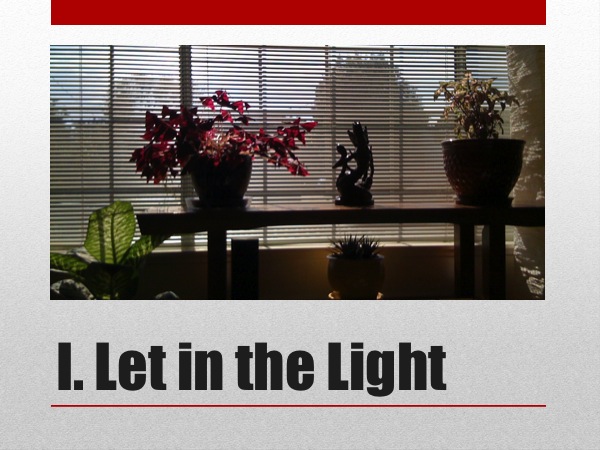
I. LIGHT
Keep a Daylight-Oriented Schedule
I laughed, and then cried a little, when multiple consecutive speakers at MIT’s graduate student orientation implored us, for our own happiness, to maintain daylight-oriented schedules. As a biological night owl, I find this difficult sometimes. But when it gets dark out at 3:30pm, it’s really easy to sleep through the only hours the sun was actually out for. Right before New Year’s Eve, I was stuck in a cycle of working until 5am and sleeping until 2pm. Over the course of three or four days, I saw the sun for only a couple of hours. This has obvious implications for vitamin D levels (and general sanity). You don’t want to feel like you’re living in Bladerunner.
If you search Google for your ZIP code plus the word ‘sunrise,’ you’ll get tomorrow’s sunrise time. I recommend brute force here. Just keep setting your alarm clock for that time until you can wake up within a couple hours of it.

Get a Sunrise Alarm Clock. Yes, it looks hokey, but if you don’t have a window facing East, or any window at all, this thing is a lifesaver. I got it when I lived in an English basement apartment (realtor speak for a windowless deathtrap). The gradually increasing amount of daylight changed mornings immediately, so they no longer felt like someone had poured a bag of rice on my head at 4am.
In fact, use bright lights in general during daylight hours. Intense light is still the best known treatment for Seasonal Affective Disorder. You don’t’ have to pay a ton of money for fancy lights. The magic number is 10,000 lumens. A lightbox this bright helps over 50% of people who use it. Check out the Center for Light Treatment and Biological Rhythms at Columbia University for more information.

Actually, just put lights everywhere. Pick up warm lamps of all kinds. My Dad’s annual Random Christmas Gift this year was a glowing orange ionic salt lamp from the Museum of Science gift shop. Use rope light and holiday lights under desks and beds and other hidden places to give a nice ambient glow, without a tacky string of plastic visible. Pick up some candles and try not to burn your house down.

II. MOISTURE
When it’s not hailing down on you from an angry God, moisture can be your friend in the winter months. You’re going to get sick, probably multiple times, with some stupid cold or flu, and your membranes are going to hate the dry air.
Shower Reliever Effervescent Vapor Tablets
I have no idea if these actually do anything. But when the best part of your day is a scalding hot shower, these make that shower smell like eucalyptus.
Air gets crazy dry, inside and outside, in winter. Noses bleed, nails crack, skin flakes. Plug in a Humidifier, and clean it frequently. Or, for way less work, get a bunch of plants. Their respiration will keep your room more humid, and suck up some of the indoor toxins you’re spending all winter bathing in.

Stock up on chapstick. Chapped lips are the worst. Even if you don’t care about chapped lips, the person kissing you might.

Take hot showers, but go easy on the shampoo and other drying soaps. You need that oil.

Cocoa butter: It’s like moisturizer, but thicker, and smells like chocolate.

III. WARMTH
Now, you probably have heat in your home and workplace, and for that, you’re extraordinarily lucky in the grand scheme of human history. But there are lots of other ways to be warm on crappy days like today.
Wicked Good Slippers from LL Bean. LL Bean is an outdoor clothing company based in Maine. Maine knows winter. They also have lifetime guarantees and wicked good slippers, AKA moccassins. I’ve had my pair for over ten years, and despite being soft and comfortable, they haven’t worn out at all.
Good flannel sheets. You think your bed is warm, but you don’t know warm until you get these.

Boots you like make crappy weather something to look forward to. Some friends and I started noticing that, on rainy days such as today, the women among us were wearing fun, colorful boots, and smiles. They’d even remark that they were excited on rainy days, because it meant they could put on their big pink or yellow boots. Do yourself a favor and buy yourself a nice pair of boots that you actually look forward to wearing.
Guys, check out Tretorn. Ladies, a tip from Kate: You can get warm liners to go in your rubber boots.

I wish I was kidding. For the longest time, I didn’t know that real companies outside of Acme Supply, Inc. sold these man-boy suits. But it turns out that having a pair of long johns on under your jeans drastically improves being outside and being in a cold office. Plus, you can get a full red Union suit that doubles as a holiday party outfit.
Winter biking tips from Pablo, myself, and others (although I usually just avoid it in the winter, rather than ruin my bike with road salt):
You can pick up liquid coating to de-fog your biking glasses. A balaclava is well worth it. You can outfit your bike with snow tires, or any wider tires.
Coffee pot, with timer. If you’re not a morning person, it can be a lot of fun to take care of certain morning tasks the night before, and then let the robots execute the tasks in the AM. This tip shows up in a lot of “become a morning person” lists, because, the theory goes, if you smell the coffee and know the coffeepot is on, you won’t stay in bed. I’ve proven that theory wrong several times, so be sure your coffeepot also has automatic shut-off.

Drink tea, in general. Coffee’s probably what you need in the morning, but you should stop drinking it for those 8-10 hours of darkness before actual bedtime arrives (lest you ruin your Daylight-Oriented Schedule). Splurge on a few different boxes of tea. At ~10 cents a serving, you can fill many a cup of delicious warmth.
Celestial Seasonings’s Bengal Spice tea is particularly warming. The cinnamon, ginger, and cloves will warm you on so many levels. And it tastes sweet, like there’s already sugar in it.

IV. SANITY
If you haven’t noticed yet, you’re going to be inside a lot. Double down on friends. Drop the silly resolution and go to a bar and have some beers. Call someone on a telephone – they’re probably as in need of a fun conversation as you are. You might be independent in the summertime, but you need to find alternative sources of joy in the bleaker months.
Here are four mental strategies to get through winter. You can combine these as you like.

This is the kind of tip you’ll find on eHow.
Find at least one winter activity you enjoy, and that’s really best done in winter, whether it’s curling or drinking hot cocoa by the gallon. My friend looks forward to winter because she loves skiing, and skiing is an expensive enough hobby without having to fly to where the snow is.
My mother claims to love winter in New England, because it gives you every excuse you need to stay inside, cook a big meal, and be cozy. You can read the newspaper guilt-free, knowing that it’s absolutely awful outside and that there’s nowhere better to be than where you are right now. Winter kills Fear of Missing Out.

The more fun way to go is straight denial. Stock up on frozen mangos, coconut milk, and other tropical fruit to get your vitamins, and remind your taste buds that there are places in the world that aren’t dead. Yes, it breaks your localavore diet. But no, you’re not a Pilgrim, and you don’t really need to eat nothing but root vegetables for 6 months a year.
Make some tiki drinks and put a movie like Endless Summer on a projector or large TV screen.

The more likely strategy, for this MIT crowd, is to understand that while you’re more miserable than people in warmer climates, you also have no excuse to get a lot of great work done.
One benefit of staying inside is that genius goes uninterrupted, and almost-genius doesn’t have rooftop happy hours calling it away. It’s the one time of year when the warm glow of your LCD is preferable to being outside. Hunker down these next few months and go at it with all you’ve got until spring relieves you of your duties.

Lastly, we’re past the darkest day of the year, and a final great method for staying sane is to take joy in every little sign of spring you see emerging.

As of last Friday, this was the number of days remaining until the Vernal Equinox, that wonderful first day of Spring. It’s even less now!

You might notice that this is half of our previous number. Do you know what’s in 23 days?
This is the number of days until pitchers and catchers report. You know that New Englanders love the Red Sox. What you may not know is that part of this obsession with the Red Sox over the winter months, this hope, this faith, is based not in a love for the sport of baseball, which is admittedly, the slowest American sport, but because it is gone in winter, like other pleasures, and like the green grass at Fenway itself, it comes peeking back into town with the first blooms.
Pitchers and catchers report is more symbolic than meaningful; we imbued this almost random sports day with all sorts of hope and celebration, not just because we love the Red Sox (we do), but also because it serves as a “halfway to spring” party. It means things are underway, that, in a reasonable amount of time, you’ll be sitting outside in the sun somewhere with your friends and a baseball game on the radio.

This is the number of days until the spring beers come out. ‘ESB’ in this photo stands for Early Spring Beer, and others like Sam Adams’s new Alpine Spring are avaiable now, too.
Photo credits:
- http://www.flickr.com/photos/dan4th/3131548174/sizes/o/in/photostream/
- http://www.flickr.com/photos/ohlex/72401592/sizes/z/in/photostream/
- http://www.flickr.com/photos/mrwalter/3207803849/sizes/l/in/photostream/
- http://www.flickr.com/photos/f-r-a-n-k/2294809097/sizes/o/in/photostream/
- http://www.flickr.com/photos/mrwalter/3207803361/sizes/l/in/photostream/
- http://www.flickr.com/photos/mkrigsman/4320514763/sizes/o/in/photostream/
- http://www.flickr.com/photos/yarianyg/4533588997/sizes/l/in/photostream/
- http://www.flickr.com/photos/aaefros/2806117561/sizes/l/in/photostream/
- http://www.flickr.com/photos/kharied/4209460500/sizes/o/in/photostream/
- http://www.flickr.com/photos/zesmerelda/4347036728/sizes/l/in/photostream/
- http://www.flickr.com/photos/dog4aday/3909458813/sizes/o/in/photostream/
- http://www.flickr.com/photos/10349297@N00/42385358/sizes/z/in/photostream/
- http://www.flickr.com/photos/yearofthegurl/2219565343/sizes/z/in/photostream/
- http://www.flickr.com/photos/dalo9999/5059148538/sizes/l/in/photostream/
- http://www.flickr.com/photos/8374568@N07/2511890808/sizes/l/in/photostream/
- http://www.flickr.com/photos/forsytht/4552015077/sizes/l/in/photostream/
- http://www.flickr.com/photos/coincoyote/18848964/sizes/o/in/photostream/
- http://widbox.com/fireplace-tv
- http://www.flickr.com/photos/airport/17396809/sizes/o/in/photostream/
- http://www.onr.navy.mil/focus/spacesciences/images/observingsky/celestialsphere.jpg
- http://www.flickr.com/photos/kiwanc/464046403/
- http://www.flickr.com/photos/birdvoyeur/4295670355/sizes/m/in/photostream/
- http://www.flickr.com/photos/wickenden/3285279675/sizes/l/in/photostream/
-
What would a nutritional label for the news look like?
Cross-posted from the Center for Civic Media blog.
The standard US FDA nutrition label is well-known here in the states because it is both consistent (for better or worse) and ubiquitous: you’ll find it on almost all packaged foods, excluding certain foods like fresh meat (until 2012) and fresh baked goods (creating an opening in the market for cupcake detectives).
As we consider the equivalent of a nutritional label for information consumption, I’d like to strike a balance between the consistent, widely-recognized FDA label and the far more creative, dynamic approaches to visualizing information all over the internet.
Our MediaRDI project is underway, and we’ll have two classes of “newstritional” information to display (don’t worry, I won’t use that word again). Our first phase will be to display information about a given news provider, such as the New York Times or CNN. A news consumer such as yourself could see, at a glance, what sort of topics a source provides, and what you might be gaining or missing by reading it exclusively. This could also help professional journalists by visualizing what they’re covering and what they’re missing – they could even advertise their breadth of coverage or depth in a given topic.
Further down the road a bit, we might focus on visualizing the news consumption of actual individuals across their entire media diet. First, we’d have to track media consumption across web, podcasts, TV, newspaper, Twitter, and so on, and then we’d have to parse and visualize it. This phase might be most exciting to the most people, especially if we can make it easier and prettier to display aggregate information consumption.
Visualizing Media by News Provider
One example that immediately jumps to mind is an old favorite, the treemap visualization of Google News (Markos Weskamp went on to bring us Flipboard).

“Google News automatically groups news [s]tories with similar content and places them based on algorithmic results into clusters. In Newsmap, the size of each cell is determined by the amount of related articles that exist inside each news cluster that the Google News Aggregator presents. In that way users can quickly identify which news stories have been given the most coverage, viewing the map by region, topic or time. Through that process it still accentuates the importance of a given article.
“Newsmap also allows to compare the news landscape among several countries, making it possible to differentiate which countries give more coverage to, for example, more national news than international or sports rather than business.”
This approach is interesting for a couple of reasons. Treemaps are great at visualizing distributions of information in a constrained layout. They also happen to resemble the traditional newspaper column layouts we know and love. Here’s a mockup I did with LabGrab’s treemap of science news:

This visual format could be used to display the categories of news offered by a single source. The name of the news source could remain in the familiar masthead location. We could also add a dynamic slider on the right to allow the user to adjust the timeframe of news coverage represented in the treemap. A user could compare how this news provider’s coverage distributes over the last few years versus the last few weeks.
A great way to visualize the depth and breadth of topics in the news might be stream graphs, like this view of box office returns by the New York Times:

As Nathan says, they look sort of like latte art. Check out Lee Byron’s Streamgraph generator on GitHub.
I’m particularly interested in what happens when you restrict the area of a Streamgraph to something relative, like visualizing 100% of the news in a given paper, creating a Stacked Area Graph. This form allows you to see how one category of data affects another:

If we’re interested in displaying the geographic reach (or lack thereof) of a given news source, it’d be great to be able to show a heatmap of the world, with intensities representing news about those areas. We’re not necessarily able to accurately say which articles cover which geographic areas yet, but I’d enjoy this visual if I were looking to expand my international news consumption (just as the Where I’ve Been Facebook app set off a tidal wave of users visually charting where they’ve traveled and where they’d like to visit).

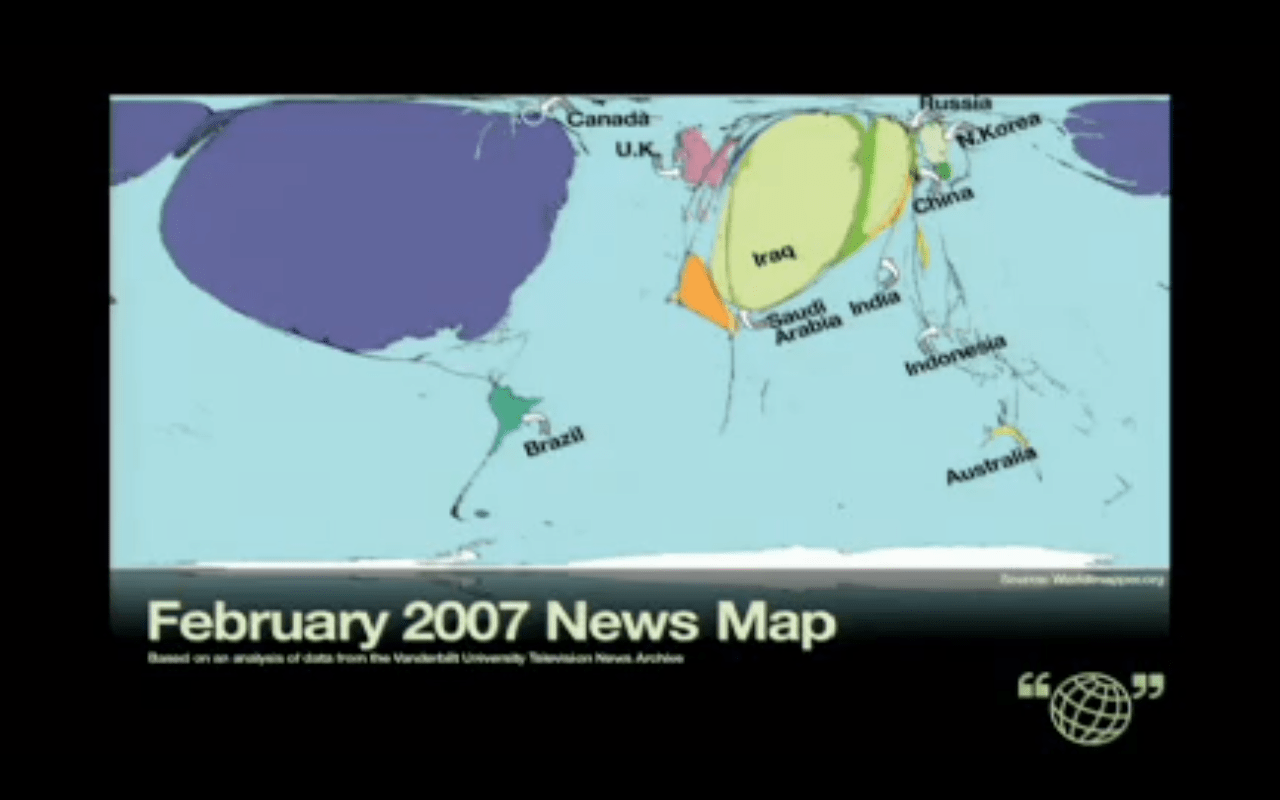
Heatmap image by igrigorik shared under Creative Commons Attribution-NonCommercial-ShareAlike license.Another approach to the world map visualization is the telling visual Alisa Miller used in her TED Talk about our news diets:

It makes one think to actually see that, as far as our news diet goes, huge swaths of our planet and fellow humanity don’t even exist to us.
Visualizing News by Personal Consumption
Given that information consumption is an exercise of the mind, first and foremost, it might also be fun and useful to display a treemap in the form of a human brain. I imagine I’d be compelled to change my habits if I could see that a large chunk of my mental intake consisted of iPhone 5 rumors.

Original brain image shared under Creative Commons Attribution-ShareAlike license.
Of course, a pie chart is a simple and great way to display percentages of a whole. Maybe we put it in a stopwatch housing to gently remind the user that the data represents how they’re spending their time, for better or worse.

Original image created by lookang shared under Creative Commons Attribution-ShareAlike license.One of the most useful personal information tools I use is Mint.com. Sure, they get every detail of my financial data, but I’m not convinced the banks didn’t have this anyway. At least with Mint I, too, get to see what my consumer profile looks like over time. Mint was wise enough to realize that financial information can be pretty boring if left to programs like Quickbooks, and has therefore prioritized visually attractive displays and interfaces. Perhaps that’s why Intuit bought Mint for $170 million.
 Mint helps individuals view their personal finances from a number of angles. First, you load all of your financial accounts, including checking, savings, loans, and credit cards. Having everything in one place allows Mint to aggregate every transaction, eliminate duplicates, and provide an at-a-glance overview of your complete financial record.
Replicating this for media consumption would likely require plugins and devices for the myriad ways we consume media, but wouldn’t be impossible. A browser extension and Twitter client could automatically log time spent with various news (like RescueTime), although certain media might require manual logging using a mobile app (like going to see a movie).
Mint also lets users set a monthly budget by spending category. This method could certainly be applied to media consumption. The budgeted categories of media and amount of time allotted to them are entirely up to the individual’s unique goals. Here’s a mockup of what this might look like:

You can also see your spending, by category, on pie and bar graphs:


Things get interesting as you dive into the compare-by-city and compare-by-state features:

Of course, not everyone has the time or inclination to dive in this deeply. For this reason, when you first log in, Mint serves up important alerts based on your activity:

Mint also selects and offers additional financial products depending on your activity. While I don’t need another credit card, I might be interested in a subscription to The Economist if I’m trying to bulk up on my international news diet.

Lastly, as we’re considering personal metrics, we should also look at FitBit and Nike Plus and how they display fitness information. Both services are loved, not only because they track and display your personal metrics, but because they build in motivational tricks that exploit human psychology to encourage healthy habits.
 Like Mint, FitBit offers in-depth analytics for true data hounds, but also an at-a-glance display of your personal metrics. In practically every review I’ve read, the FitBit device is lauded for the little blue LED flower.
Sure, FitBit’s sensors capture all sorts of data that can later be uploaded to and analyzed with their web service, but the immediate payoff for wearing the thing is a Tamagotchi-style flower that thrives or withers based on how much you move or sit. I’d be willing to bet that concerns for the flower’s health motivate more people than the number on a chart of a web service.
Nike Plus’s primary motivational force is peer pressure. At first, the promotional video offers “an endless parade of information” about you and your runs, and the service does offer maps, metrics, and exercise plans. But sports are competitive, and Nike Plus rightly focuses on the social element. You can directly challenge (or cheer on) friends who also use Nike Plus, not to mention brag on Facebook and Twitter.
Do you have more ideas on how to best display the numbers behind our news? Let us know in the comments, if you would. The nice thing about the MediaRDI project is that this data will be open, so designers far more talented than myself could create visually compelling interfaces for exploring our personal information metrics.
-
Capitalism: Working for You
updated the arrows to better reflect the consumer’s dominant position
In addition to the two amazing courses I’m taking for credit this semester, Intro to Civic Media (with Sasha Costanza-Chock) and Tangible Interfaces with Hiroshi Ishii, I’m auditing a class on Systems Visualization. The quick explanation is that it’s Infographics 101. But really it’s how to design visualizations that elegantly display complicated systems (the US healthcare system, climate change, the universe itself, and so on), with all of their inputs, outputs, controllers and disrupters.
Our professor, VA Shiva (who also happened to copyright email when he was 16), created a nice little cartoon visualizing the ecosystem of the modern man:
In the cartoon, a man is watching TV. The man eats at McDonald’s, so he has heart problems, but fortunately he watches his Comcast-provided cable channels and sees a commercial for Lipitor. He pays for his McDonald’s, Comcast, and pharmaceuticals with the money saved in his Bank of America account (which only costs $6 a month!). By visualizing this cocoon of consumerism, we can see how the companies benefit from his existence. Things get particularly interesting when we look at the exchanges between these conglomerates, such as when Pfizer pays Comcast to advertise to the man even as the man is paying Comcast to watch the advertisements.
Our first visual assignment was to rework this example from a different angle. I chose to have a little fun with it, and create a systems visualization where the individual him or herself is the dominant player in the system (as represented by vertical placement). These companies, and the hundreds of thousands of people they employ, work all the live-long day to provide products and services carefully designed to meet the individual’s every need or desire (hunger, health, entertainment, etc.):

-
Luca de Biase describes the Italian media landscape at Civic lunch
Cross-posted from the Center for Civic Media blog. We’re hosting weekly lunches with great guests – come by if you’re in the Cambridge area!
Ethan introduces Luca as an innovator at the junction between traditional and professional journalism in Italy. He was one of the first in the country to have a blog and solicit ideas on the journalism he performs. He’s also a commentator on Italy’s place in Europe and world as a whole.

Luca begins by describing the media landscape in Italy. Italy’s a young country populated by very ancient people, so they have both problems, he says. Italy has a long history and a rich culture, but Italians don’t speak much to the rest of the world these days.
He sees Italy as an interesting case study in what not to do in regulating the media, and how the civic media can overcome poor decisions at the policy level. Italian law allowed Silvio Berlusconi to own three television networks. Once elected Prime Minister, Berlusconi gained control of another three networks. Italy only has 7 total networks, so since 1994, Berlusconi has effectively controled 6 of the 7 TV stations. There’s only one commercial non-Berlusconi channel, owned by Telecom Italy.
As an example of the cultural and political power of television, Luca tells a story of his 1989 interview with Berlusconi. In an 8-hour interview, Luca says, Berlusconi said one interesting thing: They changed Italy by putting ‘Dallas’ on television in 1981. As far as Italians see it, the liberal capitalist wave began with Margaret Thatcher’s election in 1979, Ronald Reagan in 1980, and Dallas coming on air in 1981.
Italy was a nation of Catholics and Communists. Whichever side you were on, you were sharing. At least, until this guy J.R. came along. Italians were obsessed; people started to call their children J.R. and Sue Ellen. And since then the liberal capitalistic culture was part of Italy.
The power of television in Italy is further enhanced by the fact that 35% of the Italian population has been assessed by the OECD as functionally illiterate, meaning they can’t understand a newspaper, job offer, or bank contract. Literacy has actually declined since television became popular. Another group, CHANCES, has found that 55% of the Italian population gets their information only from the TV news.
The extreme consolidation of television networks makes civic media and the internet very important politically, even more so than in other places with more voices represented on television. The law in Italy dictates that if fewer than half of all eligible voters turn out to vote in a referendum, the referendum fails. Campaigns to defeat referenda don’t communicate why one should vote AGAINST a referendum, they need only ensure low overall turnout. For the last 20 years, turnout has been a function of how often the referendum has been mentioned on television. When the networks don’t mention the referendum, no one goes to vote, and it doesn’t pass.
Two months ago, 3 referenda were held, on nuclear power, privatization of water, and one of Berlusconi’s laws dealing with judges. As usual, the TV networks didn’t mention the three referenda, until 4 days prior to the vote, at which point they provided the wrong election day date. But this year, thanks to civic media and the internet disseminating the information, the referenda passed the minimum threshold for voter turnout, with 55% of the population voting.
As of this year, according to the CHANCES institute, over half of the Italian population is now online. Luca argues that the internet is a major area of hope for the Italian economy and for jobs for Italy’s youth, and that we need to understand what’s ahead in this space. Luca offers an example: A single Italian starts a design firm, which has redesigned furniture from the ‘60s, gets the furniture manufactured in China, and then exports it all over the world.
Like other nations, Italy’s in the middle of a financial crisis over its public debt. Any chance to overcome this crisis, as Luca sees it, lies in exports. Italy needs to shift from exporting furniture and food to exporting ideas and professional services. There’s evidence that things are beginning to move int his direction. The value of Italian exports grew 10% last year, even as the value of exports of shipped goods dropped 4%. The non-material economy will depend on more and more products, companies and ideas being developed online.
The networked space is an opportunity for the economy and for young people, and also an opportunity to change the situation in favor of democracy in Italy.
Luca shifts to the dark side. What can go wrong in the online space, and what can we do about it? “I’ve been thinking about this for a long time,” he says, “as you can see by my hair” (his hair is gray).
His main concern about the space is that there’s no reason for those online to share a common agenda. Small groups have their own agendas and communicate mainly within their small groups. How can we use the internet to reach a common purpose? [What deliberative mechanisms can we build?] The national referendum brought everyone together, but once the vote was over, the unity dissipated.
We need to build some incentives to work together, and find out how we can influence the general agenda together. Groups can still work towards their own interests, of course, whether you’re in the Christian Fundamentalist party, or the Communist party, the “Fix My Roads” party, but there needs to be a shared agenda as well.
Q&A time!
Karen’s curious about the environment in the film world in Italy.
Luca says there’s lots going on in the documentary world, less in the rest of the film industry. There’s a network of 600 filmmakers that started with just 5 people in 2006. They covered the earthquake and report via short films.Ethan: Italy made a terrible mistake in allowing concentration of ownership of television, and the practical implication of this is that you can take issues off the agenda entirely. But people have managed to rally and turn out the vote. How does that happen?
Luca: It’s a hopeful story. Beppe Grillo, a comedic actor, was very popular in the 1980’s and managed to say at a show, in front of 15 million people, that the socialists were robbing the country [they were]. He was thrown off of television and never went back. He began touring theaters and his popularity grew. He started to blog and his blog became one of the 50 most popular blogs in the world, and #1 in Italy.
Ethan: In 2004-2005, he’d show up at #11 on all of Technorati.
Luca: And that was writing only in Italian. He never links to anyone, just broadcasts what he does, information, different ideas, but isn’t responsive. He’s created a social party now, yet another party. But back to the main point, citizens are different islands of different values and we speak only with our similarly defined people, more often than not.
Luca’s interested in how we establish a shared agreement around the basic facts before we begin debating. Why can’t I know just the facts? Why must everything be an opinion? Luca brings up as an extreme example the weather in the region around Venice. After noticing that fewer tourists show up in Venice when the weather is predicted to be bad, the governor of the region declared the need for a new weather forecast system that didn’t damage the tourism economy. Facts count, Luca says, and we should agree that some things, like weather forecasts, should remain outside the realm of political alteration.
Sasha Costanza-Chock comments: Italy has a strong history of free television and free radio, as well, for 70 years, before the consolidation in TV. Through the end of the ‘90s, into the 2000s, Indymedia Italy was one of the strongest nodes in the global network and spread radical thought. And hackerspaces, squats, are very creative radical media making.
For example:
- Italian media activists / theorists / practitioners have been incredibly influential, from Gramsci and the theory of Hegemony to Italian Autonomists like BiFo, Pasquinelli, and so on.
- BiFo: [Franco Bifo Berardi: What is the Meaning of Autonomy Today?
- Radio Alice | Wikipedia
- New Global Vision (movement TV)
- Telestreet, Orfeo TV
- http://affinityproject.org/practices/telestreet.html
- A documentary about the telestreet station TMO (TeleMonteOrlando))
- A short movie about the movement
These theories and media practice have been tied to social movement practices, for example the squatting movement. So, a question: How can we recuperate that fascinating history of Italian radical media/theory production, and have that be the narrative we reproduce worldwide instead of the story of Berlusconi and control of television?
Luca answers: Being creative is a good way to be Italian, and if you are against the system and creative, that makes what you say more notorious, more popular than the real importance of what you are saying. It’s very important to say something in a strange, interesting, or creative way. But there is one part in these movements that has always been weak….these kind of movements start by defining themselves as losers. They are victims of the system. They will never win. They will only testify their ideas…Nobody really thought that any of these movements would truly change the system. It would only change the way we think about the system by having more critical ideas, and by having more spaces for saying that things are wrong. It’s not the best situation, because sometimes you would like to win or change things.
Sasha responds: So, we would have to draw from the creativity of the radical media and autonomous movements, but transform them from resistance identities to project identities, with real proposals for the transformation of society, and the possibility of real victories.
Luca: Just to agree on what is a fact for everybody, that would be a revolution!
We’re seeing similar things with economic forecasts made by international organizations. Empirical, historically credible organizations like Cofindustria [which also owns the newspaper that employs Luca] have been questioned by the government and accused of releasing reports that superstitiously create bad luck for Italy.
So, can we agree, as professional journalists do (accuracy, independence), on basic principles, like how we gather information?
“It’s not that you don’t have Fox News, it’s that we ONLY have Fox News.”
Luca started a foundation in Trento called ahref. He says the people in Trento aren’t really Italian; they start meetings on time. Trento’s 2nd biggest industry is research. They’ve invested heavily into knowledge creation.
They’re running experiments to answer questions like, “Is it possible to encode positive civic behaviors into platforms?” In their first experiment, citizens have to accept a small terms of service saying that they’ll try to be accurate, behave, and so on, and the experiment will see if taking that pledge changes behavior.
Another
Timu (Swahili for ‘team’). It lets citizens participate in research alongside the professional researchers. Already, in just two weeks, the citizen participants have helped make discoveries. A foundation in the south of Italy is trying to improve the rate of school attendance amongst children. At a school near Naples, citizens have reported that the teachers and parents agreed to bring children to school only one day a week, so they have less work to do, and that the teachers will then pass the students at the end of the year. Another program is in partnership with the Falling Walls organization in Berlin. The group organizes around the day the Berlin Wall fell and gathers scientists to discuss which other walls around the world should fall. They’re using Timu to decide which other walls should fall, and the aforementioned group of filmmakers is also participating.
Jim Paradis: How do you reconcile the power of television in Italy when the internet is available?
Luca: When 35% of Italians cannot read, they only access information on TV. Another 20% basically get their information from TV because they only get their news from word-of-mouth.
55% only had access to information through TV in 1999. This is the first year that more than half of Italians are online, meaning 49% are still not online.Those that are online are reading newspapers, watching on-demand TV, and some read foreign papers. It’s hard for outsiders to see the millions of Italians who aren’t online and can’t read a newspaper because they’re not represented.
And there are different assessments of literacy. OECD says 35% are functionally illiterate, but other studies say that number’s even higher. Tullio de Mauro, professor of Italian studies, has just published a book about illiteracy in Italy. He’s looking into how the National Statistical Organization should interview people to find out whether they read books. The handbook for interviewers says something like: “When people tell you they don’t read books, ask if they have every read a cookbook or a tourist guide. If they tell you yes, put down that they’re literate.” [ see “Levels of participation in the life of the culture in Italy” by Tullio De Mauro, Adolfo Morrone (2008)].
Jim: But isn’t there a legal mandate for fundamental literacy? Are the institutions either nonexistent or failing?
Luca: “It’s interesting your faith in institutions.” Much of Italy is elderly, and of those, many left school early, and since then, if they didn’t read or write for their job, they lost the ability to read. There’s also the problem of young people: 25% of 14-24 year-olds find it very difficult to read, which is a problem of the educational institutions. There are many stories of children not going to school, even if it’s the law. The educational budgets have been cut for 20 years.Jim: Literacy is a problem for civic media around the world.
Ethan: There are two kinds of literacy. Newt Minnow was head of the FCC overseeing TV in US, and famously called TV a vast wasteland because it wasn’t doing its job for civic engagement and education. He was just as angry and frustrated the other night at the Berkman Center. Jonathan Alter said maybe 10 million people in the US seriously follow politics. 130 million vote in the Presidential election. What do you do about the 120 million gap between knowing anything and voting? There are different levels of ability to participate throughout the population, and it’s really complicated to consider the tiers of where people are in terms of civic engagement.
Ian: Changing the norms of journalism is interesting. How does accuracy and bias become part of that change?
Ian worked for several years at a major Japanese newspaper. Values like truth and balance were shared, but there was an allowable form of bias accepted in “the angle” your story took. One of the most powerful structures in getting coverage was the “other news” category, outside of the usual. This was the real iron fist of control. Why was the popular story of the day what people gravitated towards? Topics that took time to explain the background and context of weren’t given coverage. How do we expand what can be covered by journalists to include new topics?
Luca: People need to do entertaining or revolutionary things together to get the coverage.
It’s helpful to find new angles, new formats (Matt’s note: Groups in the US will often use shiny new technology to provide an angle to get journalists interested in their issues, because they know journalist want to cover Facebook, iPhones, etc.).People often talk about doing journalism from the bottom-up. The best way to do that is to give cameras to children. Since they’re shorter than one meter, you’re literally doing journalism from the bottom up. You take a funny angle to get interest from journalists. It’s not possible to just have a boring platform where you agree to be accurate. You do that, and then you go do something compelling on top of it.
Links:
- Luca has posted some of his notes from the talk
- Italian Referendum system on Wikipedia
- Italian Referendum on Nuclear Energy: Der Spiegel
- Guardian: “Prime minister dealt second political blow in less than two weeks as opponents succeed in getting turnout above 50%”
- Guardian Environment Blog: “Voters overwhelmingly backed anti-nuclear campaigners’ demands to block any new atomic power in Italy”
- Beppe Grillo’s blog
- New Yorker Article about Beppe Grillo: “Beppe’s Inferno”
- New York Times Video about Beppe Grillo
- Confindustria, the Italian Employers Federation (Italian) | Wikipedia (English)
Thanks to Nathan Matias and Sasha Costanza-Chock, among others, for the collaborative notetaking and supplemental information and links.
-
Principles sample
Achieving Impact
The Window of Disruption Theory
The democratic potential of new media resides not in the technologies themselves, but in their disruptive force.
[wpex Research cited]
“Whatever democratic potentialities may reside in new media inhere not in the technologies themselves but in their disruptive force; whether those democratic potentialities will endure depends on the precise ways in which new media are domesticated.”
This disruptive force is neutralized as traditional gatekeepers assert control over and restrict these technologies
“New media used — but not controlled – by youth have typically provided only temporary access to the public sphere for political and cultural expression before adult gatekeepers foreclosed these opportunities.” (Light p38 FVTI) … “the youth who used media technologies but did not control media systems found traditional gatekeeping authorities, all adults, eager to assert control over and restrict these technologies’ future use” (54)
See also The Master Switch
Traditionally, the owners of voice-enabling platforms exert control over the discourse that flows there.
Consent of the Networked, also Light: “Change in postal laws in the 1870s, however, which raised rates for amateur publishers, led to a drop-off in circulation as many young people found the cost of sending out their periodicals to be prohibitively high.”
Parallels to net neutrality battles: “Many young people were drawn to wireless radio for the potential freedom it supplied…The loss of spectrum use following the Titanic disaster in the early 1910s prompted their major political action: writing letters to the mass media and testifying before Congress to call for amateurs rather than government or businesses to control the spectrum. These efforts were to no avail.” (FVTI 45)
“Questions about media policy (for example the design of media systems) that generally resolve in favor of government or corporate interests” FVTI Allen and Light, 2013
[/wpex]
[wpex Examples and applications]
lorem
[/wpex]
Tweet-length annotated Bibliography:
What it is / Author / Title / Year / Link if available
-
Celebrating Risk-Taking in Progressive Organizing
Real breakthroughs usually start with big gambles.
When an experiment doesn’t turn out as planned, though, it can lead to embarrassment. Fear of embarrassment can lead to long-term risk-averse behavior — but fundamental change doesn’t happen unless organizers bet big now and then.
So instead of hiding our failed experiments, we want to celebrate them. Going after big results can lead to huge advancements even in defeat… IF we’re honest about what we tried, why it didn’t work, and what we learned.

We know that organizers took big risks this year, and we want to celebrate the spirit of experimentation. There’s a lot to be learned from the innovations and gambles; we just need to share them.
Experimentation is practically a religion in the web startup and software development worlds. The mantras, be they ‘fail better’ or ‘fail faster,’ have helped produce countless technologies and services we rely on every day. Twitter itself was an offshoot of a failed podcast service called Odeo (remember all of the hype behind podcasting??). Facebook takes pride in their fails as proof that the company is confronting real challenges. Jimmy Wales gave a TEDx Tampa presentation on his three rather massive failures prior to starting Wikipedia (over Skype, as he was apparently one of the many Snowmageddon refugees stranded in DC last winter):
At least twenty-five startups have even published candid post-mortems detailing why and how they folded. Individually, these stories can be embarrassing. But collectively, their sharing helps others learn and combat the modern day Horatio Algers with their “22-year old founders getting rich, quickly!” magazine covers.
For examples of organizers willing to share what works and what doesn’t with their members and their peers, look to movement leaders like 1Sky and the Sunlight Foundation.
Garth Moore, Michael Silberman, and Liz Butler of the 1Sky campaign against climate change publicly shared a mis-step this September, and even wrote up a helpful case study (part 1 and part 2) to share with the online advocacy community at Frogloop:
Despite a significant financial investment and hours of planning, coding, reviewing, designing, outreach, and training to make the project a success, we were ultimately unable to achieve what we hoped. The ambition of the online organizing platform never matched the success of the offline organizing community and strategy. After 12 months, it folded.
Because they shared their time and had the humility to report back, other groups considering a similar strategy of developing a custom community platform can avoid making the same mistakes.
Their two-part report offers a useful template for others writing case studies of their own. Their format goes:
- Our Story
- Original vision and mission behind what we hoped to build
- Our plan of action
- What went wrong
- Attempts to correct
- Lessons learned (as you’ll notice, this is the longest and most detailed section)
In the same spirit, Noah Kunin at the Sunlight Foundation actually sent an e-mail blast to their members admitting the failure of one tool and online strategy this April:
One of the most important aspects of any campaign is to be unafraid to recognize that something is not working, and change direction accordingly.
…
We launched the Public=Online website with the ability for users to create Groups which people could organize around, but, unfortunately, these tools simply aren’t working and are instead slowing the entire campaign down. So we’re going to do away with the Groups function for now. This also means that we’re eliminating all the user accounts and event creation tools associated with those Groups.
…
Our new system will focus on actions and projects and not additional online networks for you to manage.
This honesty, responsiveness, and willingness to share will help us move forward, as organizers working on individual campaigns and as a collective movement.
(On a side note, it sounds like a number of organizations are struggling with how to organize groups of members online).
Maybe you needed to persuade a legislator, and used a petition from his campaign volunteers as leverage. You didn’t get his vote, but you got media coverage, gained supporters, and developed bigger power and stronger strategies for the next round. Maybe you launched an online campaign that didn’t resonate with your audience, but gave you valuable information about their values and interests. Maybe you scrapped paid canvassing to run an all-volunteer program, and discovered that you needed to change your approach in the field to make that plan succeed.
This category recognizes the pioneers who struck out in a new direction, and showed the rest of us a path to take (or not take). We’re looking for strategies, gambles and tactics that didn’t work quite the way they were planned, but provided valuable lessons nonetheless.
Let’s acknowledge the people who put their chips on the table, and celebrate their attempts to flip conventional wisdom.
We’re presenting Most Valuable Organizing Awards in four categories: Most Valuable Organizer, Campaign, Tech and Experiment. The Top 3 in each category will be announced and voted on at National RootsCamp in Washington, DC, December 11-12. Even if you don’t have an experiment to nominate, you can participate by voting for your favorites.
Lastly, for more on leveraging failure for better future results, check out Lifehacker’s posts on the topic.
Fail quote illustration by Pretty/Ugly Design shared under Creative Commons license. Evan Sutton contributed to this post.